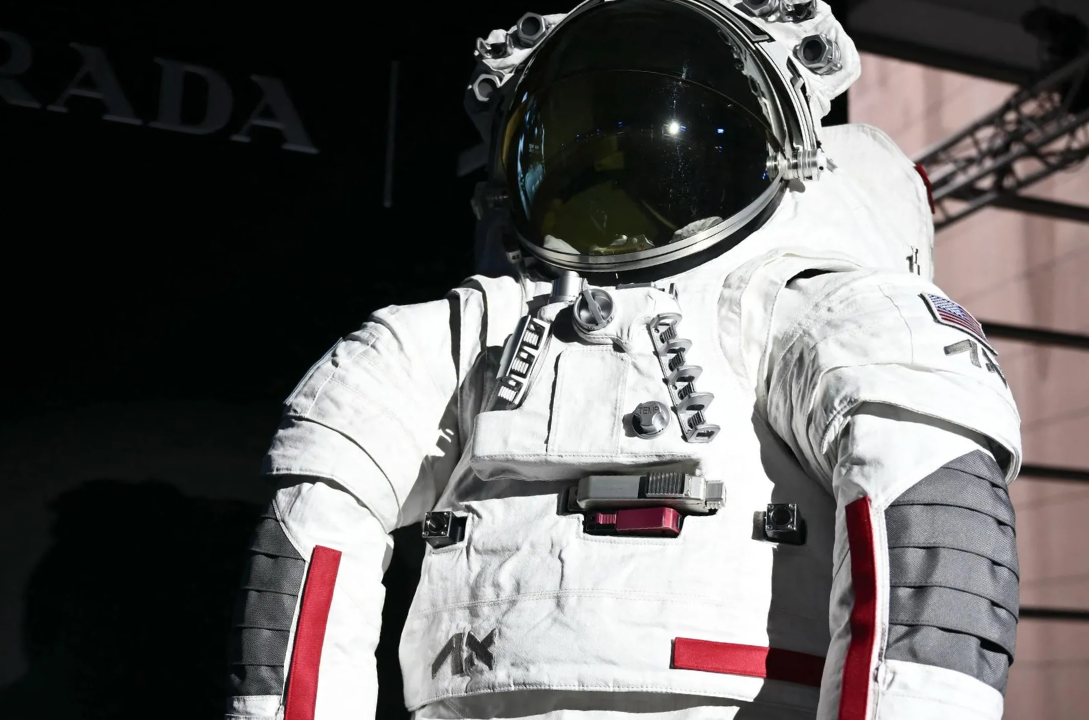
Prada is pushing deeper into the space industry, marking a new stage in the relationship between luxury fashion, advanced materials, and commercial space exploration. The Italian luxury house unveiled an inner-layer garment designed for NASA astronauts, developed in collaboration with Houston-based Axiom Space. The product, a body-hugging Liquid Cooling and Ventilation Garment, includes ventilation tubes knitted directly into the fabric and is designed to support astronaut comfort and thermal control during space missions.
The move highlights Prada’s ambition to become the first major luxury group to build a serious presence in the space sector. The project follows the brand’s earlier collaboration with Axiom on a spacesuit expected to be used for NASA’s Artemis 3 Earth orbit mission, planned for 2027, and the Artemis 4 moon landing, anticipated in 2028.
For Prada, the opportunity goes beyond brand visibility. The partnership places the company inside a high-performance design environment where materials science, wearability, engineering, and human endurance all matter. It also connects the brand with a new frontier for affluent consumers, as space tourism and commercial space infrastructure continue to develop.
The luxury industry is watching closely. Prada’s move comes at a difficult time for high-end fashion, with the sector still recovering from two years of contraction and facing fresh pressure from geopolitical disruption, weaker travel demand, and softer discretionary spending. In that context, space is not only a design theme. It may become a strategic platform for differentiation, innovation, and long-term relevance.
Why Prada’s Space Partnership Matters
Luxury brands have long used space as a source of inspiration. Futuristic collections, metallic materials, helmet-like silhouettes, and moon-age campaigns have appeared repeatedly across fashion history. Prada’s latest move is different because it moves beyond inspiration into operational partnership.
The company is not simply presenting a space-inspired runway collection. It is contributing technical knowledge to a garment that astronauts are expected to use in real missions. That changes the market narrative. Prada is positioning itself not only as a fashion house, but also as a design and materials partner capable of working in one of the most demanding environments imaginable.
This matters because luxury brands increasingly need to prove relevance beyond traditional handbags, shoes, ready-to-wear, and accessories. Consumers are more selective, younger buyers are harder to retain, and the high-end market is looking for new cultural signals. Space exploration offers a powerful one: it combines innovation, ambition, exclusivity, science, and status.
For investors, the partnership also signals how luxury companies may try to defend pricing power. A brand associated with technical excellence and future-facing design can justify a stronger premium than one relying only on heritage. Prada’s space push is therefore both a branding move and a strategic attempt to attach the company to a sector with long-term growth potential.
The Role of Axiom Space
Axiom Space is central to the project because it connects Prada’s design capabilities with actual space infrastructure development. The Houston-based company is involved in spacesuit development and broader commercial space ambitions, making it a natural partner for a fashion group seeking entry into the sector.
The new garment is not a decorative item. It is part of the functional system astronauts need for thermal regulation. Space suits must manage heat, comfort, pressure, mobility, and safety in conditions where conventional clothing design does not apply. A liquid cooling and ventilation layer helps remove excess body heat and maintain operational comfort.
That is where Prada’s expertise becomes relevant. Luxury fashion houses work extensively with textiles, ergonomics, fit, construction, durability, and movement. While fashion and space engineering appear unrelated at first glance, both require close attention to how materials behave on the human body.
The collaboration also reflects a broader trend: space exploration is no longer dominated only by government agencies and aerospace contractors. As commercial space activity grows, companies from different sectors may contribute specialized knowledge. Apparel, materials, software, robotics, data, energy, health technology, and communications can all become part of the space economy.
Space Tourism Creates a New Luxury Frontier
One reason luxury brands are interested in space is the rise of space tourism. Companies such as Blue Origin and SpaceX have helped make private space travel a more visible part of the ultra-high-net-worth consumer landscape. While the market remains small, it carries enormous symbolic power.
Luxury brands follow wealth, aspiration, and cultural attention. Space tourism combines all three. It attracts affluent consumers, generates global media coverage, and represents one of the most exclusive experiences available. For a luxury house, being associated with that environment can elevate brand perception.
Prada’s work with NASA-linked missions also gives the brand credibility that pure marketing would not provide. Rather than simply targeting wealthy space tourists with branded apparel, Prada is participating in mission-oriented garment development. That creates a more serious foundation for future products, partnerships, or brand extensions.
The commercial opportunity may not be immediate or large in traditional retail terms. Space tourism will not replace handbags or leather goods as a revenue engine. But it may influence brand positioning, innovation storytelling, and access to a customer segment that values exclusivity and technological prestige.
Luxury Needs New Relevance in a Tougher Market
Prada’s space push comes against a challenging luxury backdrop. The sector has struggled after two years of contraction, and recent signs of stabilization were disrupted by the Iran war, which affected travel and luxury spending beyond the Middle East. Luxury demand is highly sensitive to confidence, tourism, wealth effects, and geopolitical stability.
When travel is disrupted, luxury sales can suffer because high-end shopping is often tied to international tourism. Flagship stores in major cities depend heavily on global visitors. A decline in travel flows can quickly affect sales momentum, especially for brands exposed to discretionary spending.
That makes differentiation even more important. In a slower market, luxury brands cannot rely only on broad consumer demand. They need distinct narratives, innovation, and cultural relevance. Prada’s space work helps the brand stand apart from peers by linking it to aerospace, science, and future exploration.
This does not mean Prada is abandoning fashion. Instead, it is expanding what luxury can mean. The brand is showing that luxury may include technical performance, extreme-environment design, and participation in the next generation of human exploration.
Will Other Luxury Brands Follow?
The key question is whether other luxury houses will follow Prada into space. The answer is likely yes, but not by copying directly. In the luxury industry, originality matters. Leading brands generally avoid appearing to imitate one another, especially at the top end of the market.
Other fashion and apparel companies have already explored space-related partnerships. Under Armour has worked with Virgin Galactic on space apparel, while Columbia Sportswear has collaborated with Intuitive Machines on space fabric technology. These examples suggest that apparel expertise can have a role in the space sector.
For the upper tier of luxury, however, the approach may differ. Brands such as Louis Vuitton, Hermès, and Chanel may explore space through travel goods, materials, interiors, hospitality, art, cultural patronage, or advanced design rather than astronaut garments. Each house will likely seek a route that matches its own identity.
Prada’s advantage is being early and credible. By working directly with Axiom Space and connecting to NASA missions, the brand has created a first-mover narrative. That can be difficult for competitors to replicate without appearing late.
Space as a High-Performance Materials Market
The most practical long-term value may come from materials and product innovation. Space garments require durability, flexibility, temperature management, comfort, weight efficiency, and reliability. Lessons learned from these designs could influence future high-performance apparel on Earth.
This is important because luxury fashion has been moving closer to performance for years. Consumers increasingly want products that combine elegance with utility. Technical fabrics, lightweight construction, weather resistance, and ergonomic fit are no longer limited to sportswear. They are becoming part of premium design.
A space collaboration gives Prada access to a testing ground where performance requirements are extreme. Even if only a small part of the technology transfers into consumer products, the branding value can be significant. A jacket, base layer, travel garment, or technical accessory inspired by astronaut systems could carry a strong innovation narrative.
The risk is that the project remains mostly symbolic. To generate long-term value, Prada will need to connect the space initiative to broader product development, research capabilities, and consumer storytelling. The strongest outcome would be one where space work feeds both brand image and technical know-how.
Investor Implications for Prada and Luxury Stocks
For investors, Prada’s move is not likely to transform near-term earnings by itself. The space garment is not a mass-market product, and the direct revenue contribution is likely limited. The more important question is how the initiative affects brand equity, innovation perception, and long-term positioning.
Luxury valuation often depends on intangible strength: desirability, scarcity, cultural relevance, pricing power, and global recognition. A successful space partnership can strengthen those intangible assets. It can make Prada feel more modern, more technically advanced, and more connected to future-facing consumers.
However, investors should remain realistic. Space partnerships cannot offset weak consumer demand, travel disruptions, or macroeconomic pressure alone. Prada and its peers still depend on execution in core categories, regional demand trends, inventory discipline, and pricing strategy.
The initiative is best understood as a strategic signal. Prada is trying to widen the meaning of luxury at a time when the sector needs new growth narratives. If it succeeds, the brand may gain cultural advantage even before meaningful financial gains appear.
What Markets Should Watch Next
Markets should first watch how the Prada-Axiom collaboration develops ahead of the Artemis missions. If the garments are successfully used in high-profile NASA-linked missions, the brand value could increase significantly.
The second factor is whether Prada turns the technical work into consumer-facing innovation. Space-derived materials, cooling systems, performance layers, or limited-edition collections could help translate the partnership into commercial relevance.
The third factor is whether other luxury houses enter the space economy. If multiple brands move in, space could become a new luxury category theme. If Prada remains the most credible player, its first-mover advantage may grow.
The fourth factor is the broader space tourism market. If private spaceflight expands and becomes more visible, luxury brands will have more opportunities to serve ultra-affluent consumers.
The fifth factor is the health of luxury demand. If geopolitical tensions and weak travel continue to pressure spending, innovation narratives will matter more, but they may not fully offset weaker sales conditions.
Conclusion
Prada’s collaboration with Axiom Space on NASA-linked astronaut garments marks a notable expansion of luxury beyond traditional fashion. The project places the brand inside the space industry, where technical performance, materials science, and human-centered design are critical.
The move gives Prada a first-mover position among major luxury groups and connects the brand to space exploration, commercial space travel, and future-facing design. While the direct financial impact may be limited in the near term, the strategic value lies in brand differentiation, innovation credibility, and access to a new cultural frontier.
Final Takeaway
Prada’s space push is not just a publicity exercise. It reflects a broader shift in luxury, where brands must combine heritage with innovation to stay relevant. If space travel becomes a meaningful market for high-end consumers and technical design, Prada has positioned itself early in a sector where exclusivity, performance, and imagination meet.