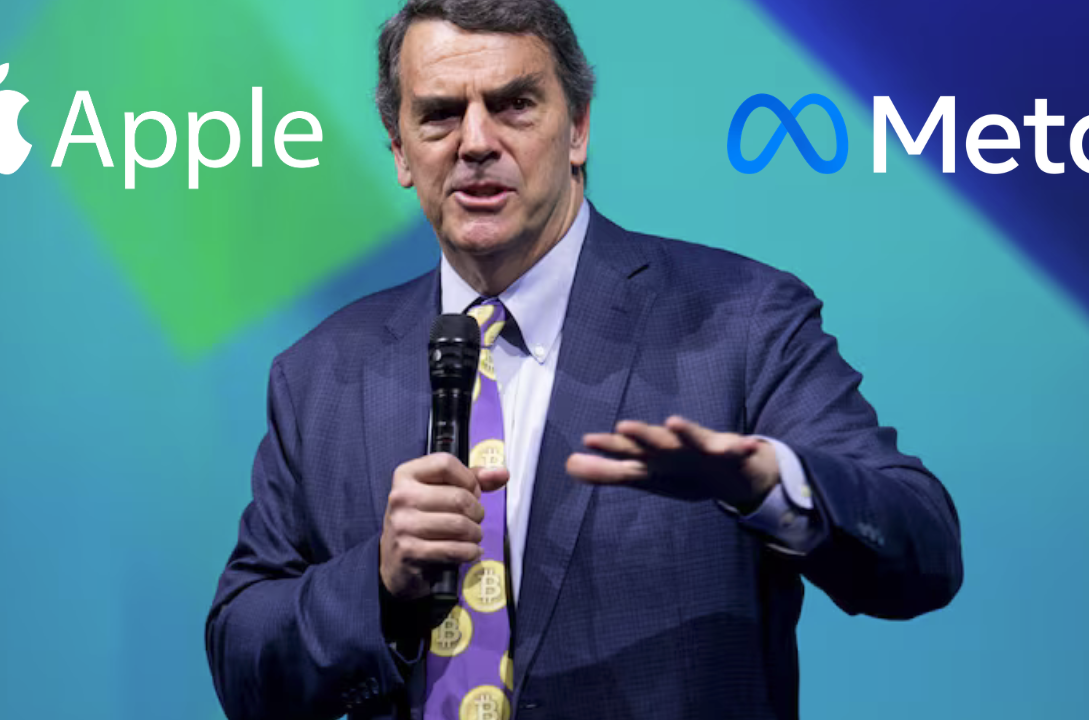
Billionaire venture capitalist Tim Draper has urged Apple and Meta to add Bitcoin to their corporate treasuries, arguing that large technology companies face financial risk when they keep their reserves entirely outside BTC. His comments were published on Sept. 21 following a 30-minute interview in which he described it as “irresponsible” for major companies to maintain no Bitcoin exposure. Draper framed the issue as a question of resilience rather than simply a bet on price appreciation, tying his argument to concerns about U.S. fiscal policy, monetary instability and the risks that can arise when corporate cash remains concentrated within the traditional banking system.
Draper’s comments reflect his personal investment view. They do not indicate any change in treasury policy at Apple or Meta, and neither company’s latest quarterly filing discloses Bitcoin among its treasury assets. The two technology groups continue to report large pools of cash and marketable securities held through conventional instruments.
Draper argues for Bitcoin as an operating reserve
During the interview, Draper said businesses should consider holding roughly four weeks of operating expenses in Bitcoin. He also suggested that individuals could hold around six months of expenses in BTC and that governments should maintain Bitcoin exposure as protection against problems in traditional monetary systems.
His argument goes beyond the conventional idea of Bitcoin as an inflation hedge. Draper said companies that hold no Bitcoin could be vulnerable if banks holding their cash fail. In his view, Bitcoin offers an alternative asset that sits outside the conventional banking structure and could provide another form of financial resilience.
That reasoning reflects Draper’s broader support for decentralized finance. He has long promoted Bitcoin as part of a system that can reduce dependence on centralized intermediaries. In the latest interview, he connected blockchain technology with artificial intelligence, smart contracts and software automation, arguing that technological development could reduce reliance on payment intermediaries, accountants and other centralized service providers.
Fiscal concerns shape Draper’s argument
Draper linked his position to U.S. government spending and warned that the fiscal path could eventually lead either to hyperinflation or to interest rates high enough to create problems for banks. The newsletter stresses that this outcome is highly uncertain. No official U.S. projection says hyperinflation is inevitable, and current fiscal data do not establish that such a scenario will occur.
The figures cited do, however, show continued large federal deficits. U.S. Treasury data showed a $167 billion federal deficit in August. During the first 11 months of fiscal 2026, federal outlays reached about $6.8 trillion, while receipts totaled around $4.8 trillion, leaving a cumulative deficit close to $2 trillion.
Those numbers document the government’s current borrowing requirement. They do not confirm Draper’s prediction that the fiscal path must end in hyperinflation or a banking crisis. His conclusion remains an investment thesis rather than an official economic forecast.
Apple still reports a conventional treasury portfolio
Apple’s latest quarterly filing illustrates the scale of the balance sheet Draper wants partly exposed to Bitcoin. As of June 27, Apple reported $39.54 billion in cash and cash equivalents, $22.86 billion in current marketable securities and $84.12 billion in non-current marketable securities. Together, those categories totaled approximately $146.5 billion.
The filing lists cash, money-market funds, U.S. Treasury securities, government agency securities, corporate securities and other conventional investments. The newsletter notes that a search of Apple’s Form 10-Q produced no reference to Bitcoin.
Apple’s February 2026 annual shareholder meeting also did not include a Bitcoin treasury proposal. The five voting items covered directors, the company’s auditor, executive compensation, a director stock plan and a shareholder proposal concerning China.
No disclosed Bitcoin allocation at Apple
Draper did not say that Apple had discussed purchasing Bitcoin or that he had spoken with the company about changing its treasury policy. His comments were directed at what he believes large technology companies should do with part of their liquid reserves.
That distinction matters because Apple’s current disclosures show no move toward a Bitcoin treasury strategy. The company continues to hold its liquidity through instruments traditionally used for corporate cash management. Draper’s recommendation therefore represents an outside proposal rather than evidence of an internal shift.
Meta also keeps its liquid reserves outside Bitcoin
Meta presents a similar balance-sheet picture. As of June 30, the company reported $15.46 billion in cash and cash equivalents and $74.80 billion in marketable securities, giving it approximately $90.3 billion across those categories.
Its disclosed portfolio included money-market funds, U.S. government securities, agency debt, corporate debt and marketable equities. The latest Form 10-Q contains no reference to Bitcoin.
Unlike Apple, Meta has already faced a formal shareholder request to evaluate Bitcoin for its treasury. A 2025 shareholder proposal asked the board to prepare an assessment of whether adding Bitcoin would serve shareholder interests. The board recommended voting against the measure, saying its existing treasury management process already considered multiple investable asset classes.
The proposal was submitted by Ethan Peck on behalf of a family trust. It argued that holding conventional cash and bonds could reduce purchasing power and asked Meta to evaluate Bitcoin as another potential reserve asset.
Meta shareholders rejected the proposal by a wide margin
At Meta’s annual meeting on May 28, 2025, shareholders rejected the Bitcoin treasury assessment. The company recorded 3,916,871 votes in favor, 4,980,828,562 against and 8,857,588 abstentions.
The result showed that the proposal attracted very limited support among voting shareholders. Meta’s board had already argued that a separate Bitcoin assessment was unnecessary because the company’s treasury team considers a broad range of assets through its existing process.
Draper’s latest comments therefore come after Meta shareholders have already had an opportunity to vote on whether the company should formally study Bitcoin as a treasury asset.
Microsoft shareholders also rejected a Bitcoin assessment
Microsoft faced a similar shareholder initiative several months earlier. At its December 2024 annual meeting, shareholders voted against a proposal requesting an assessment of investing in Bitcoin after the company’s board recommended opposition.
The filing cited in the newsletter showed that only 0.55% of votes supported the proposal. About 28.23 million shares voted in favor, while more than 5.14 billion voted against.
Microsoft argued that its treasury team already evaluates a range of investment assets and did not need the requested assessment. The result provides another example of a large technology company where shareholders did not support a formal push toward Bitcoin treasury exposure.
Taken together, the Meta and Microsoft votes show that corporate Bitcoin adoption remains uneven. Bitcoin supporters continue to promote the asset as a treasury alternative, but large technology companies have largely maintained conventional approaches to liquidity management.
Draper keeps his $250,000 Bitcoin forecast
Draper also repeated his long-standing $250,000 Bitcoin price target during the interview. He now links the target to future Bitcoin halvings and the resulting reduction in new supply.
The target remains Draper’s forecast and does not come with a guaranteed timeline. The newsletter notes that several of his earlier Bitcoin price calls included dates that passed before the target was reached.
His latest treasury argument is therefore connected to a broader bullish view of Bitcoin, but the two claims are distinct. Draper is recommending that companies hold Bitcoin as a reserve asset while separately maintaining a high long-term price target.
Corporate Bitcoin strategies have produced mixed outcomes
The broader corporate Bitcoin treasury model has expanded enough to create a distinct class of listed companies whose valuations are closely tied to their crypto holdings. At the same time, some treasury companies have faced pressure when Bitcoin prices declined or financing costs increased.
Strategy remains the best-known corporate Bitcoin adopter, although its treasury approach changed during 2026 as the company managed financing obligations and liquidity. Recent reporting cited in the newsletter documented a shift from constant accumulation toward more active treasury management after the company began selling portions of its Bitcoin holdings.
That experience highlights a central point in the debate. Holding Bitcoin can offer exposure to an asset outside traditional cash and bond markets, but it also introduces price volatility and treasury-management considerations that differ from conventional corporate reserves.
Draper’s recommendation remains an outside investment view
Nothing in the newsletter indicates that Apple or Meta plans to buy Bitcoin. Draper did not disclose discussions with either company, and neither company’s latest filings report BTC holdings. His Sept. 21 remarks were an investment recommendation made during an interview.
The argument rests on his belief that Bitcoin can provide protection against monetary instability and failures within the banking system. Apple and Meta, however, continue to disclose large conventional portfolios made up of cash, government securities and other marketable investments.
The comparison between Draper’s view and current corporate practice shows how far apart Bitcoin advocates and many large technology companies remain on treasury strategy. Draper sees zero Bitcoin exposure as an unnecessary risk. Apple and Meta, based on their latest filings, continue to manage tens of billions of dollars without disclosing BTC.
For now, the debate remains theoretical for both companies. Apple has not presented a Bitcoin treasury proposal to shareholders, while Meta has already seen such a proposal rejected. Microsoft shareholders also rejected a similar assessment. Draper continues to argue that major corporations should reconsider that position, but there is no evidence in the material provided that Apple or Meta has moved toward adopting his recommendation.
His position remains a challenge to prevailing treasury practice, not evidence of an announced corporate shift, and the latest disclosures from both companies continue to show conventional reserve management without reported Bitcoin holdings.