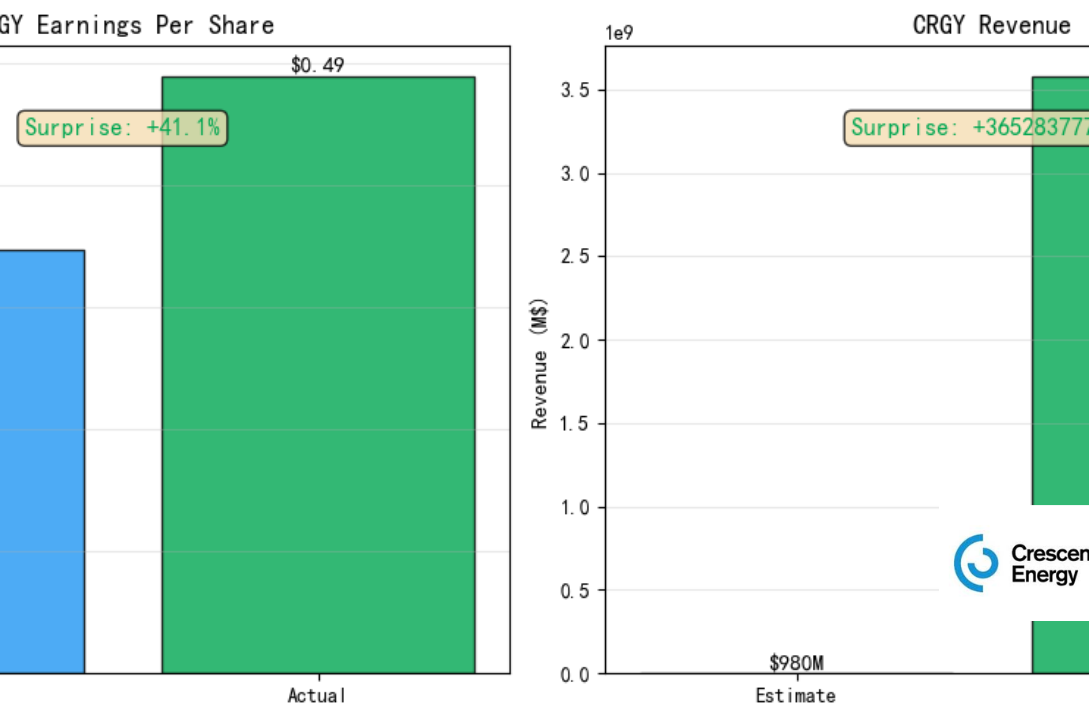
US energy stocks remain on investors’ radar, and Crescent Energy will be one of the companies closely watched this week. The oil and gas producer is set to report first-quarter results after the market closes on Monday, at a time when the exploration and production segment remains sensitive to oil prices, capital discipline and expectations for cash generation.
Crescent Energy enters the release with a mixed recent track record. Last quarter, the company beat analysts’ revenue expectations, reporting $865 million in sales, down 1.2% year over year. At the same time, the result sent mixed signals: earnings per share topped estimates, but EBITDA missed analysts’ projections by a wide margin. Oil production came in at 106,000 barrels per day, up 8.2% year over year.
Now, the market expects Crescent Energy’s revenue to grow 25% compared with the same period last year. That would be a meaningful increase, although it marks a slowdown from the 44.5% growth recorded in the same quarter last year. The expectation creates a test for the company: investors want to know whether Crescent can turn production and revenue growth into stronger margins, cash generation and better operational predictability.
Crescent Energy heads into earnings with more optimistic expectations
One of the most relevant points ahead of the release is the shift in analyst sentiment. Over the last four weeks, Crescent Energy’s revenue estimates have seen more upward revisions than downward revisions. This suggests that part of the market is becoming more confident in the company’s ability to deliver a stronger-than-expected result.
Positive revisions before an earnings release can have an important impact on stock behavior. They indicate that analysts are adjusting their models to reflect more favorable conditions, whether due to commodity prices, production volumes, acquisitions, operating efficiency or improved demand.
However, this optimism also raises the bar. When expectations rise ahead of the report, the company needs to deliver consistent numbers to avoid disappointment. Revenue merely in line with forecasts may not be enough if investors are already expecting a stronger result.
For Crescent Energy, this matters because the company has missed Wall Street’s revenue estimates multiple times over the past two years. Therefore, even with recent positive revisions, the market is likely to assess the result with caution.
Last quarter left a mixed reading
Crescent Energy’s latest earnings report was not simple to interpret. Revenue of $865 million beat analysts’ expectations but was down 1.2% year over year. Earnings per share also came in ahead of expectations, which was positive at first glance.
However, EBITDA came in well below projections. This is important because, in the oil and gas sector, EBITDA is a closely watched metric for measuring operating performance, cash-generation capacity and efficiency before financial and accounting items.
A company can beat revenue and EPS but still disappoint on EBITDA if costs are higher, margins are pressured or the production mix is less favorable. For energy investors, earnings quality matters as much as revenue growth.
That is why the first-quarter report will be analyzed not only at the top line but also in terms of Crescent’s ability to deliver better operating profitability.
Oil production remains a key indicator
Oil production will be another central point in the earnings release. Last quarter, Crescent Energy reported production of 106,000 barrels per day, up 8.2% year over year. That growth showed operational expansion, but the market will want to know whether the trend continued in the first quarter.
For exploration and production companies, volumes are essential. Higher production can boost revenue, dilute fixed costs and improve operating efficiency. But production growth needs to come with cost control and solid realized pricing.
If Crescent shows production growth with costs under control, the market may interpret the result as a sign of solid execution. If volumes disappoint or costs rise more than expected, the reaction could be negative even if revenue increases.
Production mix also matters. Oil, natural gas and natural gas liquids have different pricing dynamics. A company more exposed to oil may benefit more from strong crude prices, while greater gas exposure can bring volatility depending on regional market conditions.
The expectation for 25% year-over-year revenue growth is one of the most important figures ahead of the report. This increase may reflect higher production, better realized prices, acquisitions or a combination of these factors.
Still, the expected growth is slower than the 44.5% recorded in the same quarter last year. That slowdown does not necessarily signal weakness. It may simply reflect a tougher comparison base or a more normalized expansion pace.
However, the market will watch whether the company can maintain relevant growth without sacrificing margins. In energy, growth alone is not always enough. Investors want cash generation, capital discipline, shareholder returns and debt control.
If Crescent delivers revenue growth along with stronger EBITDA, the report may be well received. If revenue rises but profitability disappoints again, the market may question the quality of the expansion.
Peer comparison sends mixed signals
Some companies in the upstream and integrated segment have already reported first-quarter results, offering clues about the sector environment. Northern Oil and Gas reported an 11.1% year-over-year revenue decline but beat analysts’ expectations by 3.1%. Its shares rose 1.4% after the result.
CNX Resources, meanwhile, posted revenue growth of 67.1% and beat estimates by 44.1%. Even so, its shares fell 3.7% after the release. This reaction shows that, in the energy sector, beating revenue does not always guarantee a stock rally.
Investors evaluate several layers: margins, costs, production, guidance, cash flow, debt, hedging, capital returns and management commentary. A company can deliver strong revenue growth and still fall if the market sees risks elsewhere in the report.
For Crescent Energy, this means the result will be judged broadly. Revenue will matter, but it will not be the only factor.
Positive sentiment in the energy sector
The upstream and integrated segment has shown positive sentiment in recent weeks. Shares in the group have risen 4.1% on average over the past month. This advance suggests investors are more interested in the sector, possibly because of energy prices, demand, company discipline and demand for commodity exposure.
Crescent Energy, however, was unchanged over the same period. This can be read two ways. On one hand, the stock did not participate in the sector’s average recovery, which may suggest company-specific caution. On the other, it may indicate room for recovery if earnings come in strong.
The stock is trading around $13.54, while the average analyst price target is $16.64. That gap suggests upside potential based on current projections, but that potential depends on execution and market confidence in the coming quarters.
What could drive the stock after earnings
For Crescent Energy shares to react positively, several elements would be important. The first is revenue above expectations, especially if accompanied by solid production. The second is improvement in EBITDA, since that was an area of disappointment last quarter.
The third point is guidance. If management expresses confidence in production, costs and cash generation for the rest of the year, investors may react favorably. The fourth is capital discipline. The energy market has rewarded companies that do not grow at any cost but balance investment, debt and shareholder returns.
It will also be important to watch any comments on acquisitions, asset integration or operating efficiency. Crescent Energy has a strategy that may involve asset growth and consolidation, so execution quality will be essential.
Risks that could pressure Crescent Energy
Despite recent analyst optimism, there are relevant risks. The first is the possibility of another EBITDA disappointment. If the company again misses estimates on this metric, the market may question its ability to convert revenue into operating profit.
The second risk is commodity volatility. Oil and gas prices can change quickly, affecting revenue, margins and valuation perception. Even a well-managed company can struggle if realized prices are weaker than expected.
The third risk is leverage. Energy companies pursuing expansion strategies need to keep close watch on their balance sheets. If the market sees excessive debt growth or reduced financial flexibility, the stock may be penalized.
The fourth risk is peer comparison. If other companies in the sector deliver stronger results or clearer guidance, Crescent may look less attractive even with growth.
In Monday’s release, investors should focus on several key points:
● Total revenue versus the expected 25% growth
● Adjusted EBITDA and operating margins
● Daily oil production and production mix
● Operating costs and capital expenditures
● Free cash flow
● Net debt and leverage
● Production and investment guidance
● Management commentary on oil and gas prices
These elements will define whether the report is seen as confirmation of improvement or another mixed quarter.
Crescent Energy heads into its first-quarter earnings report with expectations for revenue growth, positive analyst revisions and a relatively favorable energy-sector backdrop. The market expects revenue to rise 25% year over year, while the stock trades below the average analyst price target.
But the company also faces challenges. Last quarter was mixed, with beats on revenue and EPS but disappointment on EBITDA. As a result, investors will look for signs of operating quality, not just top-line growth.
For US energy stocks, Crescent Energy’s earnings will be an important execution test. If the company shows firm production, better margins and capital discipline, it may regain investor interest. If profitability disappoints again, the stock’s recent stability could give way to renewed pressure.