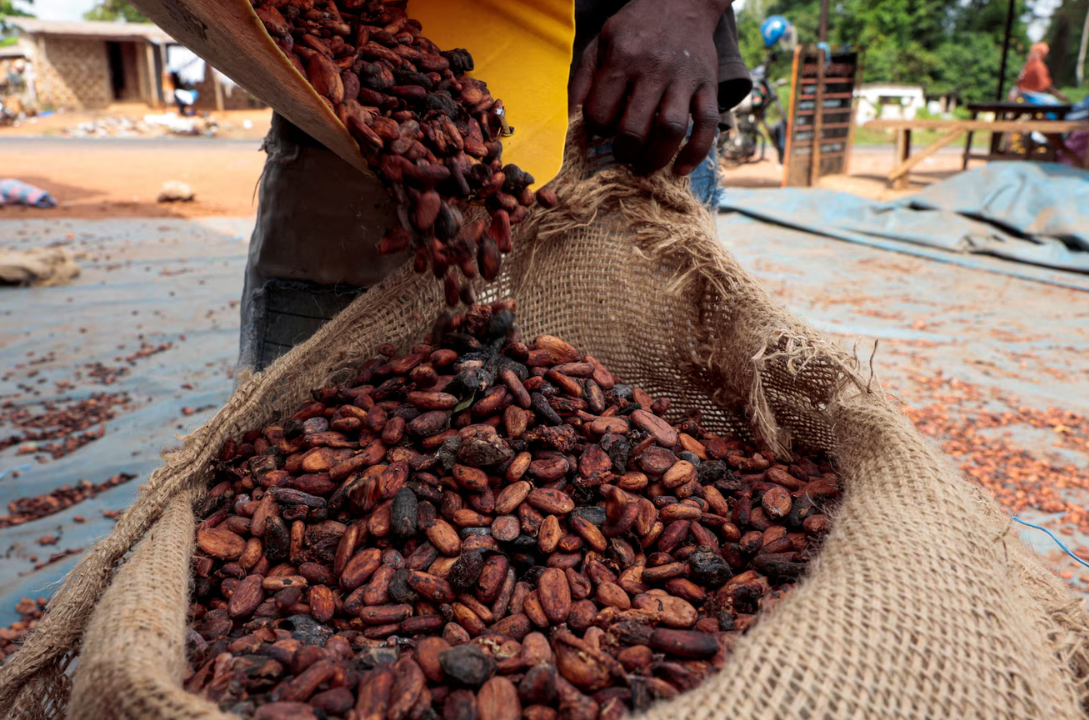
Soft commodity markets came under pressure on Monday as cocoa futures fell to two-week lows and arabica coffee dropped to a fresh 1-1/2-year low. The moves reflected growing supply expectations in key producing countries, profit-taking after recent rallies, and cautious sentiment across agricultural futures.
Cocoa led the decline after retreating from a 3-1/2-month peak reached last week. London cocoa settled down 159 pounds, or 5.2%, at 2,875 pounds per metric ton, after touching 2,821 pounds earlier in the session, its lowest level since May 5. New York cocoa also weakened sharply, falling 5.3% to $3,791 per ton after hitting an intraday low of $3,721.
Coffee also remained under pressure. Arabica coffee settled down 2.7 cents, or 1%, at $2.642 per pound, after falling to $2.6345, its lowest level in a year and a half. Robusta coffee declined 1.8% to $3,306 per ton.
Sugar moved lower as well, but losses were more limited. Raw sugar settled down 0.07 cents, or 0.5%, at 14.73 cents per pound, while white sugar lost 0.5% to $436.50 per ton.
Cocoa Extends Pullback After Recent Rally
The cocoa market has shifted sharply after a strong rally earlier this month. London cocoa had reached a 3-1/2-month high of 3,549 pounds last Tuesday, but prices have since reversed as traders reassessed the supply outlook.
The main trigger was renewed optimism over production in Ivory Coast, the world’s largest cocoa producer. Dealers cited reports that the country’s harvest could reach between 2.1 million and 2.2 million metric tons. That is significantly above the previous expectation of around 1.8 million tons.
This change matters because cocoa prices had been supported by fears of tight supply, weather uncertainty, and weak crop performance in West Africa. If Ivory Coast’s production is stronger than expected, the market may need to price in more available supply.
That does not mean all supply concerns have disappeared. But it does explain why traders moved quickly to take profits after the recent rally.
Ivory Coast Stockpiles Add Pressure
Another factor weighing on cocoa is the issue of unsold stock in Ivory Coast. The country’s cocoa regulator recently sent officials to the centre-east region to ease tensions among farmers protesting over unsold stockpiles.
Unsold cocoa can pressure prices because it suggests that available supply may not be moving smoothly through the export chain. If farmers, exporters, or regulators struggle to clear stock, the market may interpret that as evidence of weaker demand, logistical friction, or price resistance.
At the same time, exporters estimate that cocoa arrivals at ports in Ivory Coast rose 1.3% from the start of the season through May 17 compared with the same period last year. This adds to the perception that supply is improving.
For traders, higher arrivals and larger crop estimates create a bearish short-term signal. After a strong price run, even modest evidence of better supply can trigger sharp selling.
Demand Signals Limit Cocoa Losses
Despite the selloff, cocoa losses were partly limited by demand data. Ivory Coast’s cocoa grind, a measure of processing demand, rose 22% in April from a year earlier, according to data from exporters’ association GEPEX.
Cocoa grind figures are important because they show how much raw cocoa is being processed into products such as cocoa butter, cocoa powder, and liquor. Strong grind data can suggest healthy demand from chocolate makers and processors.
This creates a more balanced picture. On one hand, supply expectations are improving. On the other hand, demand indicators are not collapsing.
The short-term price reaction was still bearish because supply headlines dominated the session. But if processing demand remains strong, it could help stabilize prices after the current correction.
Arabica coffee hit another fresh 1-1/2-year low as the market continued to price in expectations of a strong Brazilian harvest. Brazil is the world’s largest arabica coffee producer, so its crop outlook has a major influence on global prices.
Broker ADM said the market is anticipating a strong Brazilian arabica harvest, which is just getting underway, and that this is keeping a negative bias on prices.
A large Brazilian crop can pressure prices because it increases expectations of supply availability in the global market. When traders believe a record or near-record harvest is coming, buyers often step back, expecting lower prices ahead.
That dynamic appears to be weighing on arabica. The market is not only reacting to current supply, but also to expectations for future export availability once the harvest advances.
Brazilian Farmers Hold Back Sales
Interestingly, lower coffee prices are also affecting farmer behavior. Brazilian broker Carvalhaes said in a weekly note that falling prices continue to hurt sales volumes, with farmers holding on to stocks even as the harvest of a likely record crop progresses.
This is a common pattern in agricultural markets. When prices fall quickly, producers may choose to delay sales, hoping for a rebound. That can slow physical market activity even when production prospects are strong.
However, farmer holding does not always support futures prices immediately. If the market believes supply will eventually reach buyers, futures may remain under pressure.
For coffee, the key question is whether farmer resistance slows export flows enough to stabilize prices, or whether the size of the Brazilian harvest keeps sentiment negative.
Robusta coffee also weakened, falling 1.8% to $3,306 per ton. Robusta often has different supply drivers from arabica, with Vietnam, Brazil, and other producers playing important roles.
The decline in robusta suggests broader weakness across the coffee complex rather than an isolated move in arabica. When both arabica and robusta fall, it often signals that traders are reducing exposure to coffee as a whole.
Still, robusta markets can remain volatile because of weather conditions, export flow, and demand from instant coffee producers. For now, however, the dominant theme is pressure from the broader supply outlook.
Sugar prices also moved lower, but the decline was modest compared with cocoa and coffee. Raw sugar slipped 0.5% to 14.73 cents per pound, while white sugar fell 0.5% to $436.50 per ton.
The International Sugar Organization released a mixed outlook. It expects the global sugar market to move into a deficit of 0.262 million metric tons in the 2026/27 season. At the same time, it raised its estimate for the 2025/26 global surplus to 2.24 million tons from 1.22 million tons.
This creates a two-stage market view. In the near term, surplus supply may cap prices. Looking ahead, the possibility of a deficit in the next season could provide support.
The ISO said the price outlook over the next three months is neutral, noting that the 2025/26 surplus is modest. It also pointed out that stock building, driven by concerns over reduced fertilizer use and increased price hedging, could support prices.
Fertilizer Concerns Could Support Sugar
One important factor in the sugar market is fertilizer use. If farmers reduce fertilizer application due to high costs or supply uncertainty, future crop yields could be affected. That would create potential supply risk for the next season.
This is why sugar did not sell off as sharply as cocoa or coffee. The market has bearish near-term supply data, but also enough future uncertainty to keep prices from falling too aggressively.
Price hedging can also support the market if producers or buyers move to lock in prices. In commodity markets, hedging flows can sometimes cushion volatility, especially when the outlook is mixed rather than clearly bearish.
Why Soft Commodities Are Diverging
The soft commodities market is not moving as one block. Cocoa, coffee, and sugar all declined, but for different reasons and with different levels of pressure.
Cocoa fell because improved Ivory Coast crop expectations challenged the tight-supply narrative that had supported the recent rally.
Coffee weakened because Brazil’s arabica harvest is expected to be strong, increasing expectations of future supply.
Sugar slipped because the current season’s surplus estimate increased, but losses were limited by the possibility of a deficit in 2026/27.
This divergence matters for investors and traders. It shows that each commodity is responding to its own supply chain, crop cycle, and demand indicators.
What Traders Should Watch Next
For cocoa, traders should monitor Ivory Coast arrivals, farmer protests, unsold stock levels, and grind data. If supply estimates continue rising, prices could remain under pressure. But strong demand indicators may slow the decline.
For coffee, the key factor is Brazil’s harvest progress. If early harvest data confirms a large crop, arabica could remain weak. If weather, logistics, or farmer selling delays reduce export flows, prices may stabilize.
For sugar, investors should watch updates from the International Sugar Organization, Brazilian production data, ethanol demand, fertilizer use, and stock-building behavior.
Across all three markets, currency movements also matter. A stronger dollar can pressure commodities priced in dollars, while local currency movements in producer countries can influence farmer selling decisions.
Cocoa, coffee, and sugar all moved lower on Monday, but cocoa and arabica coffee suffered the sharpest pressure. Cocoa tumbled to two-week lows after reports suggested Ivory Coast’s harvest could exceed earlier expectations. Arabica coffee hit a fresh 1-1/2-year low as traders anticipated a strong Brazilian crop.
Sugar also declined, but its outlook remains more balanced. A larger surplus estimate for 2025/26 weighs on prices, while the possibility of a deficit in 2026/27 provides some support.
The broader message is that soft commodity markets remain highly sensitive to crop expectations. After sharp rallies, improved supply signals can quickly trigger selling. For now, traders are watching whether the latest declines represent a deeper correction or simply a reset after recent volatility.