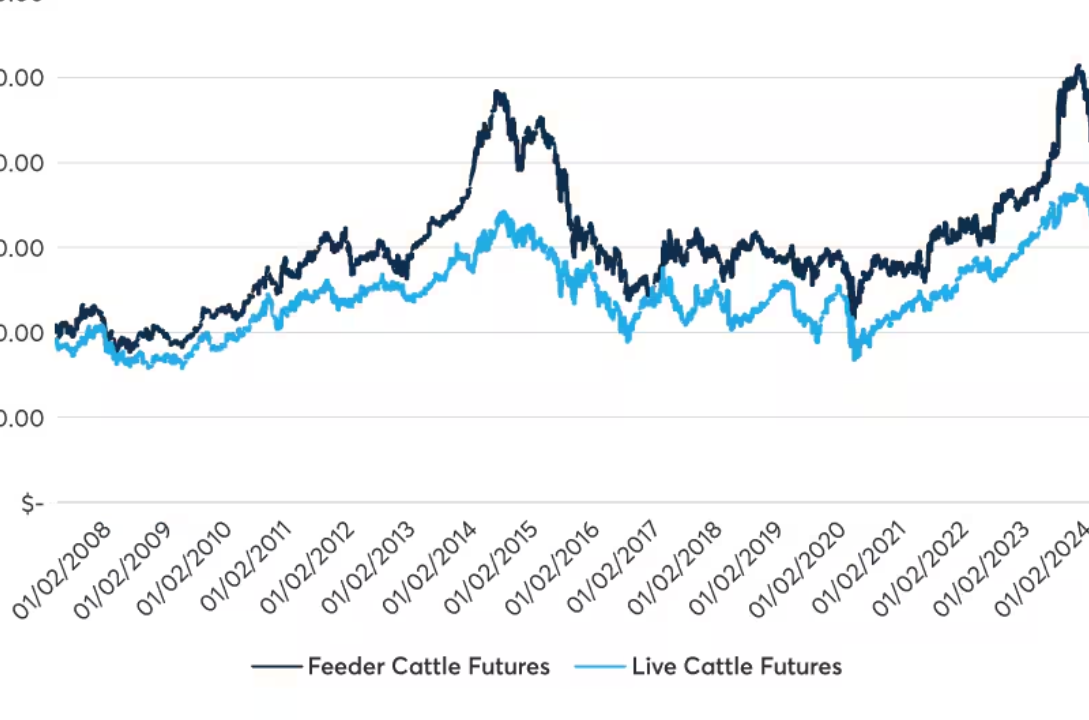
Chicago Mercantile Exchange cattle futures advanced on Monday as traders responded to a mix of technical buying, short-covering, cheaper feed costs and renewed concern over livestock supply risks near the U.S.-Mexico border. The move followed two days of declines and came as futures traded at a sizable discount to recent cash cattle prices, creating an opening for buyers to step back into the market.
August live cattle futures gained 1.550 cents to settle at 240.600 cents per pound, while August feeder cattle jumped 3.125 cents to finish at 351.550 cents per pound. The rally reflected both market structure and fundamental concerns, with traders watching the spread between futures and cash cattle, lower corn prices and the latest developments in the New World screwworm outbreak.
The most immediate supply-side concern came from news that a New World screwworm case had been found just 31 miles from the U.S. border. The United States has already been closed to Mexican cattle imports for months as cases of the parasitic pest spread northward. The latest case is the closest to the U.S. border so far in the outbreak, increasing attention on potential supply disruptions for feeder cattle and broader North American livestock flows.
For cattle traders, the issue is not only whether the pest enters the United States. The market is also pricing the risk that border restrictions, animal movement controls and import uncertainty could tighten supplies further at a time when beef prices remain historically high and consumer demand is being tested.
Why Screwworm Risk Matters for Cattle Futures
New World screwworm is a serious livestock pest because it can affect animal health and disrupt cattle movement across affected regions. When cases move closer to major cattle-producing areas or trade corridors, markets tend to pay attention quickly. Even before a direct domestic outbreak occurs, the risk of tighter import rules, quarantine measures and logistical delays can influence futures prices.
The U.S. cattle market has already been operating without Mexican cattle imports for months due to the spread of the pest. That matters because Mexico is an important source of feeder cattle for U.S. feedlots. When imports are restricted, feedlot operators may face fewer replacement animals, which can support feeder cattle prices if domestic supply is already tight.
Monday’s market reaction suggests traders viewed the latest case near the border as a fresh risk factor. The closer the outbreak gets to the United States, the more likely the market is to price in prolonged import restrictions or additional biosecurity measures.
This is especially important for feeder cattle futures. Feeder cattle prices are sensitive to both animal supply and feed costs. When available feeder supplies are constrained and corn prices fall, the economics can turn more supportive for feeders. That combination helped explain why feeder cattle futures outperformed live cattle on the day.
Futures Discount to Cash Encourages Buying
Another major driver behind Monday’s gains was the large discount between futures and recent cash cattle trades. When futures trade well below the cash market, traders may view the gap as too wide, especially if cash prices remain firm and beef demand continues to hold up.
A futures discount can create room for technical buying and short-covering. Traders who had sold contracts during the previous decline may choose to cover positions if the market appears oversold or if new supply risks emerge. That can accelerate upward movement, particularly after several sessions of weakness.
The cash market remains an important anchor for live cattle futures. If cash cattle prices stay strong while futures lag, the futures market may eventually need to adjust higher unless traders expect a meaningful drop in cash values. Monday’s bounce suggests that some market participants were not ready to price in a sharp cash-market decline.
However, the discount also reflects uncertainty. Traders are balancing resilient beef demand against concerns that consumers may eventually pull back because retail beef prices are high. That tension keeps cattle futures sensitive to both supply shocks and demand signals.
Lower Corn Prices Support Feeder Cattle
A drop in feed corn prices to multi-month lows gave additional support to feeder cattle futures. Corn is a major input cost for feedlots, so lower feed prices can improve margins for cattle feeders. When feed becomes cheaper, buyers may be willing to pay more for feeder cattle because the cost of finishing animals declines.
This relationship is one of the key links between grain markets and livestock futures. Feeder cattle often respond positively when corn prices fall, especially if cattle supplies are constrained. The decline in corn prices therefore reinforced the bullish tone created by screwworm concerns and the futures discount to cash cattle.
For feedlots, cheaper corn can help offset some of the pressure from historically high cattle prices. It does not remove all margin risk, but it can make the economics of placing cattle on feed more attractive.
Traders will continue watching whether corn prices remain near recent lows. If feed costs stay soft, feeder cattle futures may retain support even if beef demand concerns persist. If corn rebounds sharply, some of that support could weaken.
Beef Demand Remains Resilient Despite High Prices
The U.S. beef market continues to show resilience even though beef remains one of the priciest proteins on grocery store shelves. The U.S. Department of Agriculture quoted the choice boxed beef cutout at $392.83 per hundredweight, up $1.36 on Monday. Select cuts slipped by 9 cents to $383.09 per hundredweight.
The strength in choice beef suggests that demand has not collapsed despite historically elevated prices. That is important because high retail beef prices can eventually test consumers, especially when broader household costs remain elevated.
The concern is that rising gasoline prices and weaker consumer sentiment could begin to pressure beef purchases. When consumers feel squeezed, they may trade down to cheaper proteins such as chicken or pork, reduce restaurant spending or shift toward lower-cost cuts. Beef is particularly exposed to this risk because it typically carries a higher price point than other proteins.
For now, demand appears durable enough to support cash cattle and boxed beef values. But traders are watching closely for signs of fatigue. If consumers begin cutting back more aggressively, cattle futures could face demand-side pressure even if supply remains tight.
Consumer Sentiment Is the Demand Risk
The cattle market is currently caught between strong supply-side support and potential demand vulnerability. On the supply side, import restrictions, screwworm risk and tight animal availability can support prices. On the demand side, high beef prices, rising fuel costs and weak consumer confidence may limit how much retailers and consumers are willing to absorb.
This balance matters because cattle markets can remain strong only if end demand holds. Feedlots, packers and retailers all respond to consumer behavior. If beef movement slows at grocery stores or restaurants, packer margins can come under pressure, which can eventually influence bids for live cattle.
The broader economic backdrop therefore matters for cattle futures. Gasoline prices affect household budgets, while consumer sentiment affects discretionary food spending. If households become more cautious, the market may begin to question whether beef prices can remain near current levels.
That does not mean demand will weaken immediately. Beef demand has stayed resilient despite high prices. But the risk is becoming more visible, and traders may become quicker to react to retail demand signals, boxed beef movement and consumer data.
Lean Hogs Continue Lower as Funds Sell
While cattle futures moved higher, lean hog futures ended mostly lower, continuing a recent downtrend driven by fund selling. The actively traded July hog contract was the only gainer on the day, finishing up 0.350 cent at 99.850 cents per pound.
The contrast between cattle and hogs highlights different market structures across livestock. Cattle found support from supply concerns, lower feed costs and futures discounts to cash. Hogs, by contrast, remained under pressure from selling momentum.
For protein markets, this divergence is important. If beef prices remain high and consumers trade down, pork could potentially benefit from substitution demand. However, futures markets do not always price that shift immediately, especially when funds are selling or when hog supply and demand fundamentals remain less supportive.
Traders will watch whether hog futures stabilize or whether fund liquidation continues. A continued decline in hog prices could eventually influence consumer protein choices, especially if beef remains expensive.
What Traders Should Watch Next
The first issue to monitor is the New World screwworm outbreak and whether additional cases appear closer to or inside the United States. Any sign that the pest is spreading further north could increase supply concerns and support cattle futures, particularly feeder cattle.
The second factor is U.S. policy on Mexican cattle imports. If the import closure remains in place for an extended period, feeder supply could stay tighter. If authorities signal progress toward reopening trade, some of the risk premium could ease.
The third point is the relationship between futures and cash cattle. If futures continue trading at a large discount while cash remains firm, technical buying may return. If cash prices begin to weaken, the discount may become easier to justify.
Traders should also watch boxed beef values, retail demand, gasoline prices and consumer sentiment. These indicators will help determine whether high beef prices are sustainable or whether demand is beginning to soften.
Finally, corn prices remain important for feeder cattle. Cheaper feed can support placements and improve margins, while a rebound in grain prices could create renewed pressure.
CME cattle futures bounced on Monday as traders responded to screwworm worries near the U.S. border, cheaper corn and a sizable futures discount to the cash cattle market. August live cattle and feeder cattle both gained, with feeders receiving extra support from lower feed costs and ongoing concerns about restricted Mexican cattle imports.
The rally shows that supply risks remain powerful in the cattle market. However, demand concerns are also building as beef prices stay historically high, gasoline costs rise and consumer sentiment weakens. That combination means the market may remain volatile as traders weigh tight supply against the risk of softer consumer demand.
Cattle futures are being supported by supply uncertainty, lower corn prices and discounted futures values, but the demand side is becoming more important. Traders should watch screwworm developments, Mexican cattle import policy, boxed beef prices and consumer sentiment to assess whether the rally can continue or whether high beef prices will eventually slow demand.