Chicago Board of Trade corn and soybean futures ended lower on Friday as traders adjusted positions before the weekend and funds continued to liquidate exposure across agricultural markets. Wheat futures also weakened sharply, extending a difficult run as harvest-related supply pressure and technical selling continued to weigh on sentiment.
The most-active CBOT corn contract settled 1-1/2 cents lower at $4.41-1/2 a bushel. Soybeans ended 3/4 cent lower at $11.56-1/4 a bushel. Wheat posted the steepest decline among the major grain contracts, losing 11-3/4 cents to close at $5.89-3/4 a bushel.
The session came one day after corn had staged a technical reversal, supported by ideas that the market may have become oversold. However, that recovery did not carry into Friday’s close. Instead, traders turned cautious ahead of key US Department of Agriculture acreage and stocks reports due Tuesday.
Fund Selling Keeps Pressure on Grains
Fund liquidation remained one of the main forces pressuring CBOT grain futures. Traders and analysts said funds continued to unwind positions, contributing to the weaker tone in corn, soybeans and wheat.
In corn, analysts noted that funds may have unwound long positions too aggressively. That possibility helped explain why corn traded on both sides of unchanged earlier in the session after Thursday’s technical reversal. However, the market lacked enough fresh bullish news to sustain the recovery.
When funds reduce exposure quickly, futures can move lower even if some underlying fundamentals remain supportive. Positioning can become just as important as crop conditions or demand signals, especially ahead of major USDA reports.
The result was a cautious session, with market participants unwilling to build large positions before new acreage and stocks data.
Corn Fails to Build on Technical Reversal
Corn had shown signs of stabilization in the previous session, when traders viewed the market as oversold. That reversal raised the possibility of a short-term rebound, especially with hot weather entering the Midwest forecast.
However, Friday’s trading showed that technical support alone was not enough. The most-active corn contract closed 1-1/2 cents lower at $4.41-1/2 a bushel as fund selling and pre-report positioning offset weather concerns.
The market remains caught between two competing forces. On one side, heat risks in the Midwest could become more important if they persist into July, when corn pollination typically takes place. On the other side, expected increases in US corn stocks and heavy fund selling continue to limit upside momentum.
For corn bulls, the challenge is clear: the market needs either stronger weather risk, tighter USDA data or renewed demand support to break out of the current pressure.
Midwest Heat Adds Support but Not Enough
Weather remains an important factor for grain markets. The National Weather Service forecast temperatures reaching 100 degrees Fahrenheit, or 38 degrees Celsius, this weekend as far north as the upper Midwest and as far east as the Carolinas. Hotter-than-normal weather is expected from the Plains to the Atlantic Coast through July 4.
The forecast gave some support to Chicago grains, especially because the timing of heat is becoming more important. Traders are watching whether extreme temperatures will continue into July, when Midwest corn crops typically move through pollination.
Corn pollination is one of the most sensitive stages of the growing season. Extreme heat during that period can reduce yield potential, particularly if overnight temperatures remain high or soil moisture becomes insufficient.
For now, the market has not fully priced a major weather threat. The heat forecast helped limit weakness, but it did not reverse the broader pressure from fund selling, energy losses and USDA report positioning.
Soybeans Edge Lower as Energy Prices Weigh
Soybean futures also ended slightly lower, with the most-active contract down 3/4 cent at $11.56-1/4 a bushel. The decline was modest, but it reflected the same cautious tone that affected the broader grain complex.
A drop in crude oil prices weighed on soybeans because soybeans and soybean oil are tied to biofuel markets. When energy prices weaken, the value of biofuel-linked feedstocks can come under pressure.
Soybean oil demand is an important part of the soybean complex. Lower crude oil prices can reduce enthusiasm for biofuel margins, which can then affect soybean futures.
Still, soybeans held up better than wheat and corn during the session. That suggests the market remains balanced between weather concerns, fund selling, energy weakness and expectations ahead of USDA data.
Wheat was the weakest of the major CBOT grain contracts. The most-active wheat contract fell 11-3/4 cents to $5.89-3/4 a bushel, marking its fifth daily loss in six sessions.
Traders continued liquidating positions, while supply pressure from Northern Hemisphere harvests added to the bearish tone. As harvests progress, fresh supply can weigh on prices, especially when traders do not see enough demand strength to absorb available grain.
Ted Seifried, chief market strategist for Zaner Ag Hedge, summarized the market mood by saying wheat continues to be unimpressive. That view reflects the frustration of traders looking for a stronger bullish catalyst.
Wheat has faced repeated pressure from harvest flows, fund selling and a lack of convincing demand signals. Unless weather or export developments shift the outlook, the market may remain vulnerable to additional weakness.
Northern Hemisphere Harvest Pressure Builds
The wheat market is now heavily focused on harvest pressure across the Northern Hemisphere. As new crop supplies enter the market, traders often become more cautious, particularly if yields or availability appear sufficient.
Harvest pressure can be especially difficult for wheat because the market is global and highly competitive. The United States must compete with other major exporters, including Russia, Ukraine, the European Union, Canada and Australia, depending on season and quality.
If buyers believe that supply will be adequate, they may delay purchases or pressure prices lower. That can leave futures vulnerable during harvest windows.
The latest decline shows that traders remain more focused on supply pressure than on potential crop risks elsewhere.
USDA Acreage and Stocks Reports Take Center Stage
The biggest scheduled event for grain markets is the USDA acreage and stocks reports due Tuesday. These reports are among the most closely watched in the agricultural calendar because they can reset expectations for supply, planted area and available inventories.
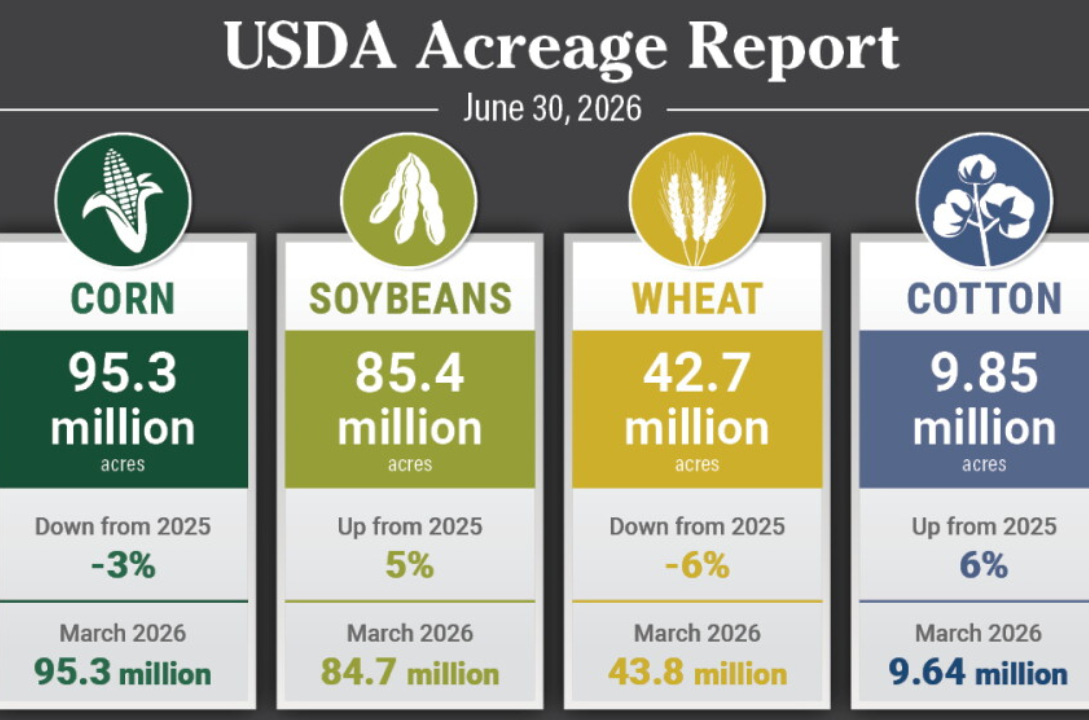
Analysts expect USDA to report that June 1 corn stocks were up 16.5% from a year earlier. The agency is also expected to report that US farmers planted around 95 million acres of corn this spring.
For soybeans, analysts expect June 1 stocks to be up about 3.8% year over year, with planted acreage around 85.4 million acres. For wheat, June 1 stocks are expected to be up 9.2% from a year earlier.
These numbers matter because they will help traders assess whether current price pressure is justified or excessive.
Corn Stocks Expected to Rise Sharply
The expected 16.5% year-over-year increase in June 1 corn stocks is one of the key bearish factors in the market. Higher stocks suggest that supply remains comfortable, which can limit the market’s ability to rally.
If the USDA confirms a large increase in corn inventories, traders may continue to question whether weather concerns are strong enough to offset the supply cushion.
However, the market reaction will depend on the difference between actual numbers and expectations. If stocks come in below the average trade estimate, corn could recover. If stocks exceed expectations, selling pressure may intensify.
The acreage number will also be critical. A planted area near 95 million acres would confirm a large production base, though weather during pollination and grain fill will still determine final yield.
Soybean Market Watches Stocks and Acreage
Soybeans face a more balanced setup ahead of the USDA reports. Expected June 1 stocks are up 3.8% from a year earlier, while planted acreage is expected near 85.4 million acres.
Those figures do not appear as bearish as the corn stock expectations, but they still matter. A higher-than-expected acreage number could pressure soybeans, especially if weather remains mostly favorable.
On the other hand, any surprise reduction in acreage or stocks could support a rebound. Soybeans remain sensitive to demand signals, export flows, soybean oil prices and summer weather.
The modest decline on Friday suggests traders were reluctant to make large bearish bets before the USDA data. The market is waiting for confirmation.
Energy Weakness Hits Biofuel Feedstocks
Crude oil prices dropped as supply concerns eased, with more tankers exiting the Strait of Hormuz. That move affected agricultural markets because corn and soybeans are both linked to biofuel demand.
Corn is used to produce ethanol, while soybeans and soybean oil are used in biodiesel and renewable diesel markets. When energy prices fall, the economics of biofuel production can become less attractive.
This does not automatically mean lower grain demand, but it can reduce speculative support and pressure futures prices in the short term.
Energy-linked selling was not the only factor behind Friday’s decline, but it added to the broader weakness created by fund liquidation and pre-report caution.
Traders Avoid Big Moves Before the Weekend
Another reason for the muted session was the lack of fresh market-moving news. Karl Setzer, partner at Consus Ag Consulting, said traders showed less interest in making large position moves going into the weekend.
This is common ahead of major USDA reports. Traders often reduce risk rather than increase exposure before data that can move the market sharply.
The Tuesday acreage and stocks reports will give the market fresh numbers to analyze, even if they come close to current estimates. Small differences can matter because positioning is already stretched in some contracts.
Until then, the market may remain sensitive to weather model changes, energy prices and fund activity.
What Traders Should Watch Next
The first factor to watch is Tuesday’s USDA data. Corn stocks, soybean stocks, wheat stocks and planted acreage will set the tone for the next phase of trading.
The second factor is Midwest weather. If heat continues into July and threatens corn pollination, weather premium could return quickly.
The third factor is fund positioning. If funds continue liquidating, futures may remain under pressure even if weather risks increase.
The fourth factor is energy prices. Lower crude oil can weigh on corn and soybeans through biofuel demand expectations.
The fifth factor is wheat harvest pressure. Continued Northern Hemisphere supply flow could keep wheat futures weak unless demand or crop risks improve.
CBOT corn, soybean and wheat futures ended lower on Friday as fund selling, weekend positioning and caution ahead of USDA acreage and stocks reports pressured the grain complex. Corn settled 1-1/2 cents lower at $4.41-1/2 a bushel, soybeans eased 3/4 cent to $11.56-1/4 and wheat fell 11-3/4 cents to $5.89-3/4.
Weather remains a key variable, with hot conditions expected across large parts of the United States through early July. However, the market remains focused on fund liquidation, energy weakness and expected increases in grain stocks.
The grain market is entering a key data window. Corn and soybeans have some weather support, but fund selling and expectations for larger stocks are limiting rallies. Wheat remains the weakest part of the complex as harvest pressure builds. Tuesday’s USDA acreage and stocks reports will likely determine whether recent selling continues or the market begins to stabilize.