Chicago grain futures were little changed on Tuesday as traders paused ahead of key U.S. Department of Agriculture acreage and quarterly grain stocks reports. Corn, wheat and soybeans remained under pressure after recent declines, but selling slowed as the market waited for fresh supply data that could reset expectations for the next stage of trading.
The USDA reports, due at 1600 GMT, are expected to provide updated estimates on U.S. planting and grain inventories. These figures are especially important because corn, wheat and soybeans are all on course for monthly and quarterly declines.
September corn on the Chicago Board of Trade was down 0.1% at $4.10 a bushel by 1113 GMT, holding close to Monday’s contract low of $4.07. CBOT soybeans slipped 0.2% to $11.37 a bushel, while CBOT wheat eased 0.1% to $5.79 a bushel after touching a two-week low.
USDA Data Becomes the Main Market Event
The grain market is now focused almost entirely on the USDA acreage and quarterly stocks reports. These reports can significantly affect price direction because they clarify how much land farmers planted and how much grain remains available in storage.
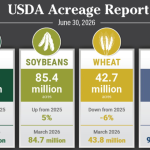
For corn, traders are watching whether the USDA lowers its acreage estimate. Analysts, on average, expect a reduction in corn acreage, though some believe farmers may have made only marginal cuts despite higher fertilizer costs linked to the Iran war.
For soybeans, analysts expect the USDA to raise its planting estimate. A larger soybean acreage number would suggest a more comfortable supply outlook, especially if weather remains mostly favorable through the growing season.
Quarterly stocks will also matter. If inventories are larger than expected, the market may interpret that as confirmation of weaker demand or more comfortable supply. If stocks come in below expectations, prices could find support.
Corn remains one of the most closely watched contracts because it recently fell to contract lows. September corn traded near $4.10 a bushel, only slightly above Monday’s low of $4.07.
The pause in selling suggests traders are reluctant to press the market much lower before the USDA numbers. However, the technical picture remains weak. A contract trading close to its lows usually reflects bearish sentiment, especially when there is no strong demand signal to offset supply concerns.
Corn has been pressured by a favorable start to the U.S. Midwest growing season, strength in the dollar and falling oil prices after de-escalation in the Middle East war. Lower oil prices can weigh on corn because of the crop’s connection to ethanol demand.
If the USDA confirms a large planted area or comfortable stocks, corn may struggle to recover. If the report shows a smaller acreage cut than expected, bearish pressure could continue.
Soybeans Ease Ahead of Planting Estimate
Soybeans edged lower to $11.37 a bushel as traders awaited confirmation of planted acreage. The market expects the USDA to raise its soybean planting estimate, which could reinforce the idea of a larger supply base.
A higher soybean acreage number would be bearish if weather conditions remain favorable. More planted acres increase the potential for a larger crop, assuming yields hold.
However, soybeans may still respond strongly if the USDA number differs from expectations. If acreage is lower than anticipated or stocks are tighter, the market could rebound quickly from current levels.
Soybeans have also been pressured by a stronger dollar and softer energy prices. While soybeans are not as directly tied to energy as crude oil itself, soybean oil is connected to biodiesel and renewable diesel demand. Falling oil prices can therefore reduce some support for the broader soybean complex.
CBOT wheat slipped to $5.79 a bushel after hitting a two-week low. Wheat remains under pressure from harvest activity and expectations for strong production in the Black Sea export region, including Russia.
Concerns about a drought-diminished U.S. wheat crop have provided some support, but that concern has been tempered by a brisk U.S. harvest pace. When harvest moves quickly, new supply enters the market and can weigh on futures.
The global wheat market is also highly competitive. If the Black Sea region produces a bumper crop, export competition may limit upside for U.S. wheat.
That makes the USDA stocks data important, but wheat may remain heavily influenced by global supply expectations and export pricing.
Favorable Midwest Weather Pressures Corn and Soybeans
A favorable start to the U.S. Midwest growing season has been one of the main bearish forces for corn and soybeans. Good early-season conditions increase confidence in crop development and reduce the need for a strong weather premium.
Traders are still monitoring hot weather across much of the Midwest this week. Heat can become a major risk if it persists during sensitive crop stages, especially corn pollination.
However, showers and easing heat are forecast in the coming days, which are expected to limit potential crop stress. That outlook reduces the urgency for buyers to build weather-risk positions.
For now, the weather picture is not threatening enough to reverse the broader correction in grain prices.
Dollar Strength Remains a Headwind
A stronger U.S. dollar has added pressure to grain markets. Since U.S. corn, soybeans and wheat are priced in dollars, a firmer dollar can make American exports more expensive for foreign buyers.
This matters because export competitiveness is a key part of the grain demand outlook. If U.S. grain becomes less attractive relative to supplies from South America, the Black Sea or Europe, futures can weaken.
Dollar strength also reflects broader macro pressure, including expectations around U.S. interest rates and global risk appetite.
In the current environment, grains are not only reacting to crop fundamentals. They are also being influenced by currency movements, energy prices and broader commodity sentiment.
Falling Oil Prices Weigh on Corn and Soybeans
Falling oil prices have also pressured corn and soybeans. The decline followed de-escalation in the Middle East war, reducing some of the risk premium in energy markets.
Lower oil prices can weigh on corn because corn is used to produce ethanol. When energy prices fall, ethanol margins can come under pressure, reducing enthusiasm for corn demand linked to biofuels.
Soybeans are also affected through soybean oil, which is used in biodiesel and renewable diesel. If energy prices weaken, biofuel-linked demand expectations may soften.
This does not mean biofuel demand disappears, but it can reduce speculative support in grain futures, particularly during periods when supply expectations are already comfortable.
Correction May Depend on USDA Surprise
Ole Hansen, head of commodity strategy at Saxo Bank, said the USDA acreage and quarterly grain stocks reports may determine whether the current correction has largely run its course or whether markets still need to adjust to a more comfortable supply outlook.
That is the key question. Grain futures have already fallen significantly, and traders may be reluctant to continue selling unless the USDA confirms a bearish supply picture.
If the reports show smaller corn acreage, tighter stocks or less comfortable supplies than expected, the market could stabilize. If the data confirms larger soybean acreage, high corn stocks or comfortable wheat inventories, the correction could continue.
The reaction may be especially sharp because traders have been adjusting positions ahead of the release. Markets often move quickly when USDA numbers differ from expectations.
European grain and oilseed futures were mixed. Paris wheat fell 0.86% to 200.75 euros per metric ton, while Paris maize rose 0.64% to 235.25 euros per metric ton. Paris rapeseed declined 0.59% to 509.75 euros per metric ton.
The weakness in Paris wheat reflected broader pressure in global wheat markets, including expectations for strong Black Sea output. Rapeseed also moved lower, likely reflecting broader oilseed and vegetable oil pressure.
Paris maize moved higher, showing that regional factors can diverge from Chicago markets. European weather, local supply conditions and currency movements can all affect Paris contracts differently from U.S. futures.
Still, the global tone remains cautious as traders wait for USDA data and monitor weather across major producing regions.
What Traders Should Watch Next
The first factor to watch is the USDA acreage report. Corn and soybean planting estimates will shape expectations for U.S. production potential.
The second factor is quarterly grain stocks. Larger-than-expected stocks would reinforce bearish supply concerns, while tighter stocks could help prices recover.
The third factor is Midwest weather. If heat returns during key crop stages, weather premium could rebuild.
The fourth factor is the U.S. dollar. Continued dollar strength would remain a headwind for export demand.
The fifth factor is oil prices. Lower energy prices can continue to pressure corn and soybeans through biofuel demand expectations.
Chicago corn, wheat and soybean futures were little changed on Tuesday as traders waited for USDA acreage and quarterly stocks reports. September corn traded near Monday’s contract low, soybeans eased slightly and wheat touched a two-week low.
The broader trend remains weak, with all three major grain contracts on course for monthly and quarterly declines. Favorable Midwest weather, dollar strength, falling oil prices and expectations for comfortable supplies have weighed on prices.
The USDA reports may decide whether the recent correction in grain markets is close to ending or whether futures need to adjust further to a more comfortable supply outlook. Until the data is released, traders are likely to remain cautious, with corn, wheat and soybeans stuck near recent lows and vulnerable to any surprise in acreage or stocks.