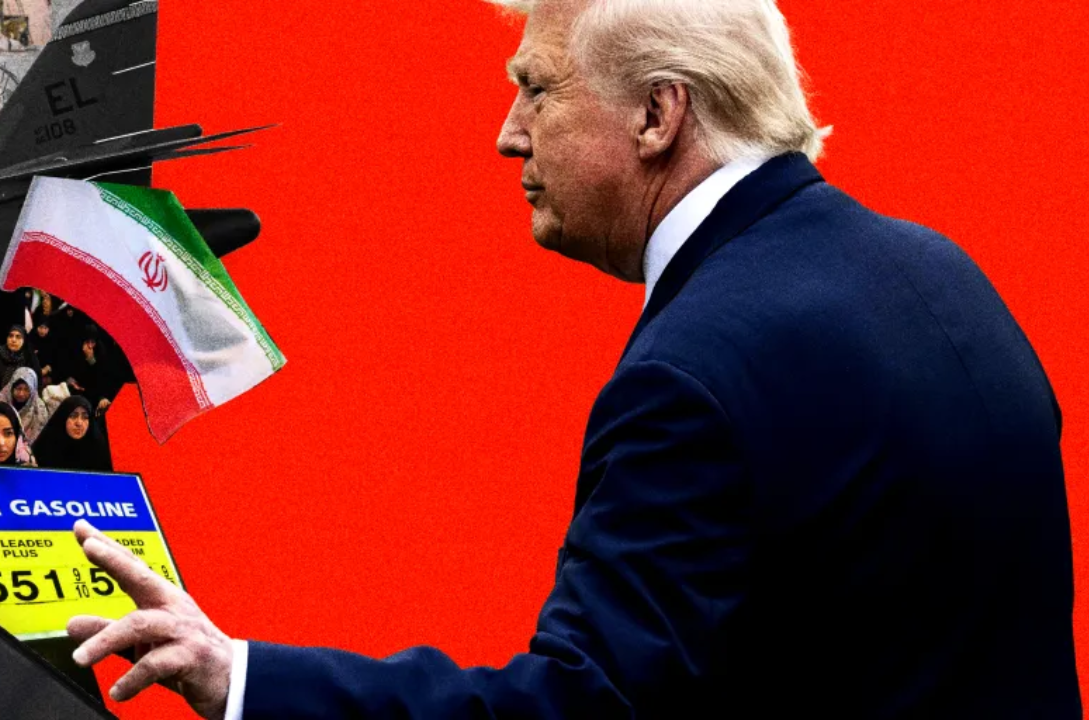
Amid the constant stream of Donald Trump’s controversies, executive actions, foreign policy escalations, and campaign-style messaging from the White House, it can be easy to lose sight of the issue that often matters most in American politics: the economy. For months, Trump and the Republican Party were already facing a difficult political environment built around inflation fatigue, cost-of-living pressure, and doubts about whether voters were genuinely feeling economic improvement in daily life. Now the Iran war appears to be making that problem significantly worse.
The political danger for Trump is not just that the war is controversial on its own. It is that the conflict is increasingly being linked, in the public mind, to rising gas prices, greater economic pessimism, and a sense that the administration is focusing too much on foreign confrontation while not paying enough attention to domestic pain. That combination is especially toxic in an election cycle. Military action can sometimes rally public support in the short term, but when voters believe it is making their own lives more expensive, the political effect changes quickly.
New polling suggests exactly that kind of shift is underway. Americans are becoming more negative about Trump’s handling of the economy, more worried about gas prices, and less willing to accept the idea that short-term pain is justified by long-term strategic goals. That matters enormously with the 2026 midterm elections only months away. If the public comes to see the Iran war not only as risky abroad but also as directly responsible for financial stress at home, the political consequences for Trump and Republicans could be substantial.
Trump’s economy problem was already serious before the war
One of the most important points in understanding the current moment is that Trump did not enter the Iran war from a position of economic strength. The war did not create his political vulnerability on the economy. It appears to be intensifying a weakness that already existed.
For months, inflation and cost-of-living pressure have remained central concerns for American voters. Even when macroeconomic data improved in some areas, many households continued to judge the economy less by broad indicators and more by what they were paying for groceries, gas, rent, utilities, and debt. That kind of voter psychology is hard to reverse once it settles in. People do not need to study economic reports to decide whether they feel financially squeezed. They make that judgment every time they fill up the tank or check out at the store.
Trump had already been struggling with that environment. His broader political appeal may remain strong within parts of the Republican base, but on the economy specifically, there were growing signs that voters were not giving him the benefit of the doubt. The Iran war appears to have taken an existing liability and poured fuel on it.
That is what makes the current polling especially significant. It is not simply showing a temporary dip in sentiment tied to war headlines. It is showing deterioration in an area where Trump was already exposed.
Economic approval is falling to dangerous levels
The most striking warning sign comes from Trump’s economic approval numbers.
A Reuters/Ipsos survey released Tuesday found Trump’s approval rating on the economy at just 29%. That is not only weak. It is historically dangerous for an incumbent president heading toward a midterm cycle. According to the polling cited, it is lower than any of Trump’s previous readings and even lower than Joe Biden’s economic low point, which bottomed out at 32%.
That comparison matters politically. Biden spent much of his presidency weighed down by economic dissatisfaction, especially on inflation. For Trump now to be polling worse than Biden did on the economy is not just an embarrassing headline. It suggests the issue is becoming a genuine political anchor.
The deterioration since before the war began is especially revealing. On cost of living, Trump reportedly moved from a net approval of minus-31 in mid-February to minus-41 now. On inflation and rising prices, he slid from minus-33 to minus-45. Those are not subtle changes. They indicate a significant worsening in public perception over a relatively short period.
When voters start moving that sharply on inflation and everyday costs, it usually means they are not simply reacting to abstract economic narratives. They are reacting to felt experience. They believe things are getting worse where it matters most in daily life.
The Republican shift may be the most troubling sign of all
Perhaps the most politically dangerous part of the data is not the overall decline, but the movement inside Trump’s own coalition.
Polling cited in the analysis suggests that Republican disapproval of Trump on cost-of-living issues rose from 27% last month to 34% now. On inflation and rising prices, Republican disapproval jumped from 28% in mid-February to 40%.
Those are large numbers for a sitting Republican president. They do not mean the GOP base is collapsing or abandoning him wholesale. But they do mean economic dissatisfaction is becoming harder to contain even among voters who are otherwise predisposed to support him.
That matters because Trump’s political model depends heavily on maintaining intense loyalty among Republican voters, especially when trying to weather controversy or poor polling with independents. If cracks begin forming inside that base on a core issue like inflation, the problem becomes harder to spin away.
Voters can forgive a president on issues they do not experience personally. They are less forgiving when they feel the consequences every week in their household budget. Rising internal dissatisfaction on prices is often one of the clearest signs that a political problem is deepening.
Gas prices are turning the war into a domestic issue
The Iran war might have remained, for many Americans, a distant foreign policy issue if it had not become so directly tied to gasoline prices. But once fuel prices rise, a conflict abroad becomes a financial issue at home.
That is exactly what now appears to be happening.
A new AP-NORC poll reportedly found that 45% of Americans were extremely or very concerned about being able to afford gas in the next few months. That is up sharply from 30% near the end of Biden’s term in December 2024. This is a major increase, and it helps explain why the administration’s messaging is struggling to reassure people.
The issue is not just that prices are rising. It is that people see the war as a cause of those rising prices. That perception is politically devastating because it collapses the distinction between foreign policy and domestic economics. The war is no longer something happening “over there.” It is showing up at the pump.
That helps explain another striking polling result: 67% of Americans said it was extremely or very important for the administration to prevent rising oil and gas prices during the conflict. That is roughly the same share that prioritized stopping Iran from obtaining a nuclear weapon. In other words, the public is treating economic protection at home as just as important as one of the central strategic justifications for the war itself.
That is a huge warning sign. It means the administration cannot assume voters will separate the national security rationale from the household financial consequences. For many Americans, those two things are already fused together.
Voters are not buying the argument for short-term sacrifice
Trump has argued that even if the war creates some short-term pain at the pump, Americans should be willing to accept it in exchange for weakening Iran and potentially improving energy conditions over the longer term. The problem is that most voters do not seem willing to make that trade.
Polling shows that fully two-thirds of Americans believe people should not be expected to pay more for gas during the war. That is politically significant because it cuts directly against the administration’s attempt to justify short-term economic strain as the cost of strategic action.
In theory, presidents can sometimes persuade voters to endure sacrifice for a larger national purpose. In practice, that is much harder when inflation has already been a long-running source of frustration, trust in government is low, and the goals of the war are still seen as unclear or shifting.
Voters might tolerate temporary pain if they believe the mission is necessary, well-defined, and likely to succeed. But if they think the conflict is hurting the economy, lacks clear payoff, and could drag on longer than expected, their tolerance falls quickly. The data suggest that is exactly where the public mood is heading.
The war is making Americans more pessimistic about the broader economy
The damage is not limited to views on fuel. It is spreading into broader economic pessimism.
A CBS News-YouGov poll cited in the analysis found that Americans believed by a margin of 48 points that the war would make the economy worse in the short term. Only 15% thought it would make the economy stronger, while 63% believed it would make it weaker. Even on the longer-term question, more Americans expected the war to weaken the economy than strengthen it.
That is a serious political problem because it means the conflict is not being viewed as a contained security action with limited spillover. It is being viewed as an economic threat.
The same poll found even greater pessimism about oil and gas prices, with 58% expecting the war to push them higher over the long term and only 27% expecting lower prices. This is especially damaging because Trump has explicitly argued that the war could ultimately help reduce oil prices. If the public rejects that argument, then one of the administration’s key economic defenses loses force.
In politics, expectations matter almost as much as current conditions. If voters expect prices to remain high, they become more negative about leadership even before the full economic effects have played out. That creates a feedback loop in which pessimism itself becomes politically destabilizing.
Trump is increasingly seen as focused on the wrong things
Another key part of the political backlash is not just what the war is doing to prices, but what it says about Trump’s priorities.
For a long time, polling has shown that Americans generally prefer presidents to focus on domestic concerns when the cost of living is high. In Trump’s case, one of the most sensitive versions of that question is whether he is paying enough attention to inflation and affordability.
The CBS data suggests the war has damaged him on exactly that front. Before the war began in late February, 45% of Americans said Trump was focusing too much on international matters. That number has now jumped to 58%.
The increase among independents is especially telling, rising from 52% to 66%. Even among Republicans, the figure moved from 19% to 29%. That means the war is not only generating economic concern. It is also reinforcing the perception that Trump is distracted from what voters consider more urgent at home.
This is politically dangerous because presidents often survive policy disagreements when voters believe their priorities are fundamentally aligned with everyday concerns. But when voters decide a president is focused elsewhere while they themselves are struggling, the damage can be harder to reverse.
Even a quick end to the war may not solve the problem
One of the most uncomfortable realities for the administration is that even if the war ends relatively soon, the economic effects may not disappear quickly.
That is a crucial point. Energy shocks rarely reverse with the same speed that they arrive. Oil prices can spike rapidly and then drift lower much more slowly. Gasoline prices at the pump often follow the same pattern. Consumers tend to remember the period of pain more vividly than the technical explanation for why prices are eventually easing.
This matters because political damage can continue even after the triggering event begins to fade. If gas prices remain elevated for weeks or months, the public will keep associating that pain with the war and with Trump’s decision-making. In an election year, repetition matters. It is one thing to pay around four dollars a gallon a couple of times. It is another to keep doing it over and over while hearing political arguments that the strategy is working.
And energy prices do not stay isolated. Higher fuel costs ripple through transportation, food, shipping, services, and general consumer prices. That means the war’s economic footprint can spread well beyond the gas station.
This could become a midterm-defining liability for Republicans
With roughly seven months until the 2026 midterms, Republicans now face a troubling possibility: the Iran war may harden the economy as their biggest political weakness rather than shifting attention away from it.
That is important because war sometimes changes political agendas. It can move voters away from economic concerns and toward security or patriotism. But this conflict seems to be doing the opposite. It is reinforcing economic anxiety, not replacing it.
If that pattern continues, Republicans may be forced to fight the midterms on terrain that is increasingly hostile to them: rising prices, negative perceptions of economic management, and a president seen as responsible for making things worse. That would be especially damaging if independents continue moving away from Trump and if dissatisfaction among Republicans remains elevated enough to suppress enthusiasm.
The longer the economic pain persists, the more likely it is that the war becomes not a separate issue but part of a larger judgment about competence, priorities, and the cost of Trump’s leadership.
Conclusion
The political danger for Donald Trump is growing because the Iran war is no longer being judged only as a foreign policy choice. It is being judged as an economic burden. New polling suggests Americans are becoming more negative about his handling of the economy, more worried about gas prices, more pessimistic about inflation, and less convinced that short-term sacrifice is worth it.
Perhaps most significantly, that shift is not confined to Democrats and independents. It is beginning to show up among Republicans too. That makes the problem harder to dismiss as partisan noise.
Even if the war ends sooner than expected, the economic effects are unlikely to vanish overnight. Higher energy prices, broader inflation pressure, and a deepening sense of financial frustration could continue to weigh on Trump and the GOP well into the midterm season.
The biggest political issue was already the economy. The Iran war now appears to be making that issue even more dangerous for the White House.