Alphabet enters one of the most closely watched earnings weeks of the season with its stock roughly 15% below its record high above $400. Shares of Google’s parent company were little changed in premarket trading Monday, but the broader setup remains sensitive as investors prepare for Wednesday’s second-quarter earnings report.
Wall Street expects Alphabet to report earnings of $2.87 per share on revenue of about $117 billion, representing roughly 6% year-over-year growth. That is a solid target, but for mega-cap technology stocks, simply meeting estimates may not be enough. Investors will be looking for evidence that Alphabet can defend its core advertising business, expand cloud growth, control costs and justify rising artificial intelligence investment.
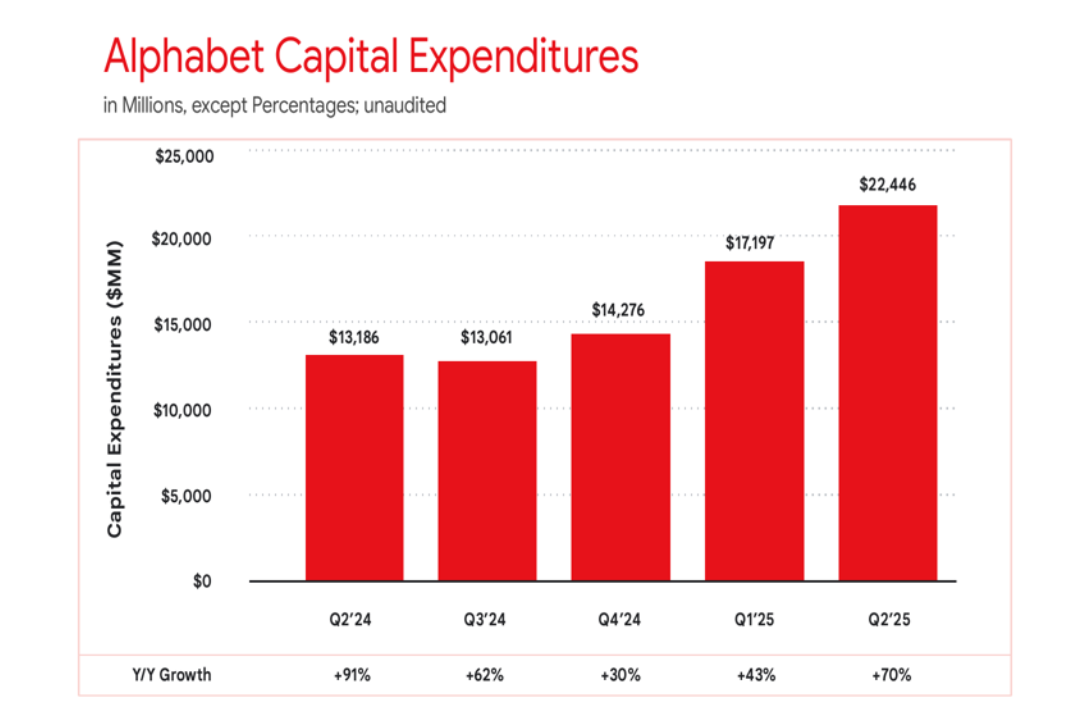
The most important number may not be revenue or earnings. It may be capital expenditure. With AI infrastructure demand accelerating, memory prices rising and competition intensifying, investors expect management to provide a clearer view of how much Alphabet plans to spend to stay ahead in the AI race.
Alphabet trades below its record high
Alphabet shares remain around 15% below their record high above $400. That pullback has created a key question for traders: is the decline a buying opportunity before earnings, or is it an early warning that expectations have become too demanding?
The answer will depend heavily on Wednesday’s report. A strong earnings release with convincing guidance could help rebuild confidence and support a rebound. A weaker report, or a sharp increase in spending without clear growth justification, could reinforce the recent weakness.
Mega-cap technology stocks often trade on a mix of current earnings and future expectations. Alphabet’s current business remains profitable and diversified, but investors are increasingly focused on whether AI investment can translate into durable revenue growth.
That is why this earnings report matters. It will test not only Alphabet’s financial performance, but also the market’s confidence in its AI strategy.
Wall Street expects $117 billion in revenue
Analysts expect Alphabet to generate about $117 billion in second-quarter revenue, up roughly 6% from a year earlier. Earnings are expected at $2.87 per share.
Those numbers set a clear baseline. Revenue growth of 6% would show that Alphabet continues to expand despite its size, but the market may want more detail on where that growth is coming from.
Investors will likely focus on Google Search, YouTube, Google Cloud, advertising pricing, operating margins and AI-related monetization. Alphabet’s scale is enormous, but scale alone does not guarantee multiple expansion. The company must show that its biggest businesses remain healthy while its newer AI initiatives create future growth opportunities.
A revenue beat would help sentiment. But if operating expenses or capital expenditure rise too quickly, investors may question whether growth is becoming more expensive.
Earnings quality will be under scrutiny
Alphabet posted record net income of $62.6 billion in the first quarter. On the surface, that number looked exceptional. But the quality of those earnings is now a major point of debate.
Nearly half of that first-quarter net income came from unrealized gains on Alphabet’s investments in Anthropic and SpaceX, rather than from its core advertising and cloud operations. That matters because unrealized gains are accounting gains, not cash profits.
Alphabet owns roughly 14% of Anthropic, whose valuation reportedly surged from $380 billion at the end of the first quarter to $965 billion after a new funding round. That increase translated into an estimated $80 billion paper gain for Alphabet.
The issue is not that these gains are irrelevant. A stake in a fast-growing AI company can be strategically valuable. But investors will want to separate paper gains from operating performance.
Unrealized gains can flatter reported earnings
Unrealized gains increase the accounting value of Alphabet’s investment holdings. They can boost reported earnings even though the company has not sold the assets or received cash.
This distinction matters for valuation. Investors generally assign higher quality to recurring operating profits than to one-time or mark-to-market gains. Alphabet’s advertising, cloud and subscription businesses generate cash. Unrealized investment gains can fluctuate sharply depending on private-market valuations.
If Anthropic’s valuation rises, Alphabet benefits on paper. If valuations decline later, those gains could reverse. That makes them less dependable than revenue from core business lines.
For Q2, investors will want to know how much of Alphabet’s earnings power is coming from operations and how much is influenced by investment revaluations. The stronger the core business looks, the less concern there will be about accounting-driven earnings.
AI investment remains central to the story
Alphabet’s AI exposure is one of the biggest reasons investors continue to watch the stock closely. The company has major AI assets across Google Search, Gemini, Google Cloud, YouTube, productivity tools and infrastructure.
However, AI also creates a spending challenge. The race to build and deploy advanced AI systems requires data centers, chips, servers, power capacity, engineering talent and long-term infrastructure commitments. Those investments can pressure free cash flow and margins before they produce full revenue benefits.
This is why capital expenditure guidance is so important. Investors want Alphabet to invest aggressively enough to remain competitive, but not so aggressively that spending appears undisciplined.
The market is no longer asking only which company has the best AI model. It is asking which company can monetize AI profitably at scale.
Capex guidance may drive the stock reaction
Capital expenditure, or capex, refers to spending on long-term assets such as data centers, servers, chips and infrastructure. In the current AI cycle, capex has become one of the most important metrics for large technology companies.
Analysts expect Alphabet management could raise 2026 capex guidance to roughly $200 billion, about 5% above previous expectations. If that happens, the market reaction will depend on how management explains the increase.
A higher capex forecast can be interpreted positively if investors believe it supports future growth in AI, cloud and search. But it can be interpreted negatively if it suggests Alphabet must spend more simply to defend its position.
That is the central tension. AI infrastructure spending is necessary, but the return on that spending must become visible.
Why $200 billion in capex would matter
A capex outlook near $200 billion would signal that Alphabet is preparing for a very large infrastructure cycle. That level of spending would likely reflect continued investment in AI data centers, advanced chips, networking equipment, storage, power and cloud capacity.
The reason this matters is that Alphabet’s future AI strategy depends on compute. Training and serving AI models require large-scale infrastructure. Google Cloud also needs enough capacity to support enterprise AI demand.
But capex can pressure financial metrics. Heavy spending may reduce free cash flow, increase depreciation and make investors more sensitive to whether AI revenue is scaling quickly enough.
If Alphabet raises capex guidance, management will need to show that demand justifies the spend. Investors will listen for evidence from cloud customers, AI product usage, search monetization and enterprise adoption.
Google Cloud will be a key segment
Google Cloud will likely be one of the most important segments in the report. Cloud growth is central to Alphabet’s AI thesis because enterprise customers increasingly need infrastructure, models, tools and data services to build AI applications.
If Google Cloud shows strong growth and margin improvement, investors may be more comfortable with higher capex. Strong cloud demand would suggest that infrastructure spending is tied to real customer demand, not speculative overbuilding.
If cloud growth disappoints, however, high capex could become harder to defend. Investors may worry that Alphabet is spending heavily without capturing enough incremental revenue.
Cloud is also important because it gives Alphabet a direct commercial channel for AI services. Search remains the company’s core profit engine, but cloud is where many enterprise AI dollars may flow.
Despite the AI focus, Google Search remains Alphabet’s most important business. Search advertising continues to provide the financial foundation that funds much of the company’s broader strategy.
Investors will watch whether Search remains resilient as AI changes user behavior. AI-powered answers, chat interfaces and new discovery tools could alter how users interact with information. Alphabet must show that it can integrate AI into Search without weakening advertising monetization.
If Search revenue remains stable or accelerates, the market may feel more confident that Alphabet can manage the AI transition. If growth slows, concerns may increase that AI is disrupting the company’s most profitable business.
This is one of the most important long-term questions for Alphabet: can it transform Search with AI while preserving the economics of Search advertising?
YouTube and advertising trends also matter
YouTube will also be closely watched. The platform remains a major digital advertising asset and an important part of Alphabet’s broader media ecosystem.
Advertising trends can provide insight into the health of consumer demand and brand spending. If YouTube performs well, it may indicate continued strength in video advertising and creator-driven engagement. If it weakens, investors may worry about competition from short-form video platforms, streaming services and social media.
YouTube also has potential AI benefits. AI tools can support content creation, ad targeting, recommendation systems and monetization. But the platform still faces intense competition for user attention.
Alphabet needs both Search and YouTube to remain strong while Google Cloud and AI products scale.
Anthropic stake adds strategic value
Alphabet’s investment in Anthropic gives it exposure to one of the most closely watched AI companies in the market. The reported valuation increase from $380 billion to $965 billion highlights the speed at which private AI valuations have expanded.
That stake may have strategic value beyond accounting gains. It can deepen Alphabet’s exposure to frontier AI, strengthen its position in the broader AI ecosystem and potentially create commercial or infrastructure relationships.
However, private-market AI valuations can be volatile. A high valuation today does not guarantee future liquidity or realized returns. Investors will therefore treat the Anthropic gain differently from operating cash flow.
The key issue is whether Alphabet’s AI investments, including Anthropic, can eventually strengthen its core businesses or create new revenue streams.
The market wants proof of AI monetization
The central investor question is shifting from “Is Alphabet exposed to AI?” to “Can Alphabet monetize AI efficiently?”
Alphabet clearly has AI exposure. It has talent, infrastructure, data, products, distribution and investment stakes. But the market wants evidence that AI will increase revenue, protect margins or create new business lines.
That proof could come from several areas: cloud AI demand, paid AI tools, improved ad targeting, enterprise adoption, search enhancements or productivity software monetization.
Without clear monetization, AI capex may look like a cost center. With clear monetization, it can be seen as a growth investment.
Wednesday’s report may not answer the entire question, but management commentary could shape expectations.
IBM and Tesla add pressure to earnings week
Alphabet reports during a busy week for major technology and industrial names. Tesla is also set to report, while IBM has drawn attention after preliminary results triggered a major single-day collapse.
That context matters because investors are not evaluating Alphabet in isolation. Earnings season can quickly change sentiment across entire sectors. If major technology companies disappoint, even strong firms can face valuation pressure.
Alphabet will headline the week as one of the most important mega-cap names. Its results could influence broader views on AI spending, digital advertising, cloud demand and big-tech profitability.
A strong Alphabet report could stabilize sentiment. A weak report could reinforce concerns that expectations for large technology companies remain too high.
The first point to watch is earnings per share. Wall Street expects about $2.87.
The second point is revenue. Analysts expect roughly $117 billion, up about 6% from a year ago.
The third point is the quality of earnings. Investors will separate core operating profit from unrealized investment gains.
The fourth point is capex guidance. A move toward roughly $200 billion in 2026 capex would be one of the biggest signals in the report.
The fifth point is Google Cloud. Strong cloud growth would help justify AI infrastructure spending.
The sixth point is Search and YouTube advertising. These businesses remain the profit engine behind Alphabet’s broader strategy.
The seventh point is AI monetization. Investors need evidence that heavy AI spending can generate meaningful returns.
Alphabet heads into Q2 earnings with its stock roughly 15% below its record high and investors focused on far more than headline profit. Wall Street expects earnings of $2.87 per share on about $117 billion in revenue, representing roughly 6% growth from a year earlier.
The key issue is whether Alphabet can show strong core operating performance while managing a rapidly expanding AI investment cycle. First-quarter net income was boosted significantly by unrealized gains tied to Anthropic and SpaceX, making earnings quality an important focus. This quarter, investors will look closely at advertising, cloud, AI monetization and capital expenditure guidance.
Alphabet’s Q2 report is a test of operating strength and AI discipline. A revenue or earnings beat may not be enough if capex rises sharply without a convincing return story. Investors want to see that Google’s core businesses remain healthy, that cloud demand is strong and that AI spending is building future growth rather than simply inflating the cost base. The biggest number on Wednesday may not be profit. It may be how much Alphabet plans to spend to stay ahead in AI.