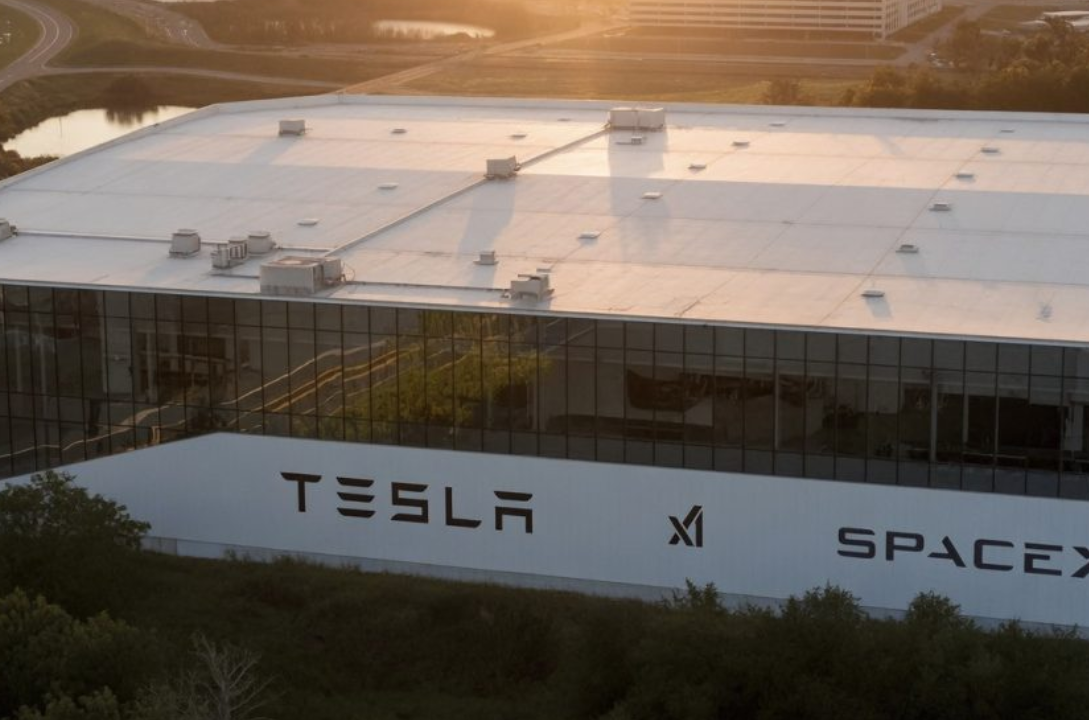
Tesla is no longer being valued only as an electric vehicle company, an artificial intelligence platform, or a bet on robotaxis and humanoid robots. A new Wall Street thesis is moving into the mainstream: the possibility that Tesla could one day merge with SpaceX.
The idea gained fresh momentum after Wolfe Research said that a future SpaceX-Tesla combination is increasingly being discussed by institutional investors. Analyst Emmanuel Rosner noted that some investors now treat a potential merger as their primary reason for owning Tesla stock. That marks a significant shift in the Tesla narrative, especially as SpaceX prepares to price what is being described as the largest initial public offering in history.
SpaceX is reportedly planning to sell 555.6 million shares at $135 each, raising $75 billion at a $1.75 trillion valuation. Trading is expected to begin on Nasdaq under the ticker SPCX. The deal is all-primary, demand is already heavily oversubscribed, and some institutions are reportedly bidding for allocations of $10 billion or more.
For Tesla investors, the SpaceX IPO matters because it could give Elon Musk a powerful new form of public equity currency. Once SpaceX becomes a listed company, the theoretical path to a stock-based transaction with Tesla becomes easier to imagine. That does not mean a merger is imminent. Wolfe Research itself sees major obstacles and does not expect any deal before mid-2027 at the earliest. But the fact that the idea is now part of mainstream institutional discussion may influence how investors value TSLA in the near term.
Tesla’s core question remains unchanged: can the company execute on robotaxi, autonomous driving, Optimus, energy storage, and AI-driven services fast enough to justify its premium valuation? The SpaceX merger thesis does not replace that question. It adds another layer to it.
Why Tesla Investors Are Looking at SpaceX
Tesla has always traded partly on future optionality. Investors have repeatedly looked beyond current vehicle deliveries and margins to price in larger ambitions: full self-driving, robotaxis, energy storage, artificial intelligence, robotics, insurance, charging infrastructure, and software revenue.
The SpaceX IPO adds a new form of optionality. If SpaceX becomes one of the most valuable public companies in the world, the market may begin asking whether Musk eventually combines his largest technology platforms into one broader industrial and AI ecosystem.
The argument is not just based on ownership or personality. Supporters of the thesis see possible strategic overlap between Tesla and SpaceX. Tesla has real-world driving data, manufacturing experience, battery expertise, robotics ambitions, and a consumer-facing brand. SpaceX has aerospace engineering, satellite infrastructure, communications, advanced manufacturing, launch capabilities, and, after absorbing xAI earlier this year, a larger AI-linked compute narrative.
A combined company, in theory, could create a broader technology platform spanning vehicles, robotics, satellite networks, energy, artificial intelligence, manufacturing, and space infrastructure. That is why some investors see the thesis as more than a financial engineering idea.
However, the market must distinguish between a compelling narrative and an executable corporate transaction. The gap between those two can be large.
The Three Forces Behind the Merger Thesis
Wolfe Research identified three major forces driving the Tesla-SpaceX merger discussion.
The first is that a public SpaceX would give Musk liquid stock currency. Private company equity is harder to use in large public-market transactions. Public stock can be valued daily, traded openly, and used more easily in an all-stock deal. Once SpaceX trades publicly, investors can compare its valuation directly with Tesla’s.
The second is voting control. A hypothetical all-stock merger could potentially increase Musk’s voting power significantly, possibly pushing it above 50% depending on the structure. For Tesla investors, governance has always been an important issue. Musk’s control, incentives, compensation, and focus across multiple companies are central to the stock’s valuation.
The third is strategic scale. A combined company could pair Tesla’s driving data with SpaceX’s compute buildout and capital base. That point matters because Tesla’s future increasingly depends on AI execution. Robotaxi, full self-driving, Optimus, and automated manufacturing all require data, compute, infrastructure, and engineering depth.
The thesis is therefore not only about SpaceX’s space business. It is about whether SpaceX’s infrastructure, capital access, and AI-related assets could strengthen Tesla’s long-term technology roadmap.
Why This Matters for TSLA Stock
Tesla shares often move on narrative as much as near-term fundamentals. Vehicle margins, deliveries, pricing, and competition remain important, but TSLA also trades on long-duration expectations. Investors buy Tesla not only for what it earns today, but for what it could become.
A mainstream SpaceX merger thesis could provide downside support for Tesla shares if investors begin assigning a premium to the possibility of future combination. Even without a deal, speculation can affect valuation. If large institutions believe TSLA is a potential entry point into a future Musk-controlled mega-platform, some may tolerate weaker near-term auto fundamentals.
That could matter at a time when Tesla’s growth story faces pressure. The electric vehicle market is more competitive, pricing power has been tested, and investors continue to wait for clear evidence that robotaxi and Optimus can move from vision to scaled commercial reality.
Wolfe’s view appears to be that merger anticipation may help support Tesla shares near term, but it does not replace execution. Rosner emphasized that robotaxi and Optimus delivery still determine whether the stock can find real momentum. That is a critical distinction. A merger thesis may create a valuation floor, but Tesla still needs operating catalysts to drive sustainable upside.
Tesla’s Core Business Still Carries the Weight
Despite the excitement around SpaceX, Tesla’s core business remains the foundation of TSLA stock. Investors must still evaluate vehicle deliveries, margins, operating expenses, pricing strategy, production efficiency, and competition in key markets such as the United States, China, and Europe.
Tesla’s future multiple depends on whether the market sees it as a car company, an AI company, a robotics company, an energy company, or a hybrid of all four. The SpaceX thesis pushes that identity even further, suggesting Tesla could become part of an even larger Musk-led technology holding structure.
But that is not guaranteed. If Tesla’s automotive margins weaken further, if robotaxi timelines slip, or if Optimus commercialization remains distant, the stock could struggle even with SpaceX speculation. Investors may be willing to assign optionality, but optionality becomes less powerful when core execution disappoints.
Tesla’s challenge is therefore twofold. It must defend its current business while proving that its next platforms can scale. Robotaxi is especially important because it could shift Tesla’s economics from vehicle sales to autonomous mobility services. Optimus could create an entirely new industrial robotics market. Energy storage could add another growth pillar. These are the catalysts that can justify Tesla’s premium valuation without relying on merger speculation.
Why SpaceX’s IPO Changes the Narrative
The SpaceX IPO changes the conversation because it gives investors a public valuation reference. A $1.75 trillion valuation would immediately make SpaceX one of the most valuable companies in the world. It would also make any future Tesla-SpaceX combination one of the most complex corporate transactions in market history.
Before an IPO, SpaceX’s valuation was mostly set through private funding rounds and secondary transactions. After listing, the market will price it continuously. That can influence the merger debate in two ways.
First, if SpaceX trades strongly, investors may see its stock as powerful acquisition currency. Second, if SpaceX trades below expectations, questions may arise about whether its valuation can support a large all-stock transaction.
Tesla investors will watch the early SPCX trading closely. If SpaceX immediately commands a premium valuation and strong institutional demand continues after listing, the merger thesis could gain credibility. If trading is volatile or the valuation is challenged, the thesis may remain more speculative.
The first days of SPCX trading may therefore influence TSLA sentiment, even without any formal merger discussion.
Bitcoin Adds Another Link Between Tesla and SpaceX
The SpaceX IPO also carries crypto relevance. The company’s filing disclosed 18,712 Bitcoin purchased for roughly $661 million in 2021, at an average price near $35,324 per coin. The position was valued at $1.29 billion as of March 31. That exceeds Tesla’s reported corporate Bitcoin treasury of roughly 11,509 BTC.
For Tesla investors, this adds another connection between Musk-linked companies and digital assets. Tesla made headlines years ago by adding Bitcoin to its balance sheet and briefly accepting Bitcoin payments before reversing that decision due to environmental concerns. SpaceX’s larger Bitcoin position places it among major corporate holders of the asset.
This does not directly change Tesla’s operating outlook. But it reinforces the perception that Musk-controlled companies are willing to use balance sheets in unconventional ways. If Tesla and SpaceX were ever combined, Bitcoin holdings, crypto exposure, and digital asset accounting could become part of the broader investor discussion.
It also shows how crypto markets are trying to price SpaceX before traditional equities can. Coinbase, Binance, and Kraken have listed SPCX pre-IPO perpetual futures, allowing crypto traders to speculate on SpaceX exposure before the stock begins trading publicly. That speculative environment could spill into Tesla sentiment because TSLA is the only large public Musk-linked equity already available to mainstream investors.
The Tesla-SpaceX merger thesis faces major barriers. Wolfe Research highlighted several.
First, Tesla would likely need to pay a large premium. SpaceX’s valuation is already extremely high, and a merger would require agreement from multiple shareholder groups. SpaceX investors may not want to exchange their shares for Tesla equity unless the terms are attractive.
Second, other SpaceX shareholders could object. SpaceX has its own investor base, strategic priorities, and governance considerations. A merger with Tesla would not simply be a Musk decision; it would require formal approvals and careful negotiation.
Third, Tesla’s China operations create regulatory complications. Tesla is deeply exposed to China through production, sales, supply chains, and regulatory relationships. Combining Tesla with a company as strategically sensitive as SpaceX could raise questions in multiple jurisdictions. SpaceX operates in aerospace, defense-adjacent technologies, satellite communications, and national-security-sensitive infrastructure. That makes regulatory approval far more complicated than a normal industrial merger.
Fourth, timing matters. Musk must hold his SpaceX shares for 366 days after the debut. Wolfe sees completion as unlikely before mid-2027 at the earliest. That means any merger thesis is not a near-term corporate event. It is a medium-term narrative.
Valuation Is the Biggest Question
SpaceX’s valuation is another source of caution. The company reportedly generated $18.67 billion in revenue in 2025 but posted a $4.94 billion net loss. That means investors are paying for growth, strategic assets, future profitability, and market dominance rather than current earnings.
Morningstar reportedly placed SpaceX fair value at $780 billion, far below the IPO valuation of $1.75 trillion. Some analysts argue that the public float may be worth only about half the headline valuation. If those concerns gain traction, SpaceX’s early trading could become volatile.
This matters for Tesla because a merger thesis depends heavily on relative valuation. If SpaceX trades at a massive premium, using its stock as currency could be attractive for Musk but difficult for Tesla shareholders to accept. If SpaceX trades below its IPO valuation, the transaction math changes.
Tesla’s own valuation is also complicated. TSLA already trades with significant expectations for autonomy, software, robotics, and energy. Combining two high-expectation companies could create an even larger premium story, but it could also concentrate execution risk.
Investors must therefore ask whether a combined Tesla-SpaceX would deserve a higher valuation multiple or whether the market would discount it for complexity, governance issues, and regulatory uncertainty.
Could a Combination Strengthen Tesla’s AI Story?
The strongest strategic argument for a Tesla-SpaceX combination is AI infrastructure. Tesla’s future depends heavily on real-world AI. Full self-driving, robotaxi networks, humanoid robots, fleet learning, and automated factories all require data, compute, and integrated hardware-software systems.
SpaceX, especially after absorbing xAI, may strengthen the compute and AI infrastructure side of the Musk ecosystem. If a combined company could integrate Tesla driving data, xAI models, SpaceX compute, satellite connectivity, and robotics development, the long-term platform argument could become more compelling.
However, integration would be difficult. Tesla and SpaceX operate in different industries, with different regulatory frameworks, customer bases, capital needs, and risk profiles. Combining them might create synergies, but it could also make the company harder to analyze.
Investors generally reward focus when execution is uncertain. Tesla already faces a broad agenda. Adding aerospace, satellites, space launch, Bitcoin exposure, AI compute, and defense-sensitive assets could make the story more exciting but also more complex.
The AI argument is real, but it would need to translate into measurable business outcomes.
Why Robotaxi and Optimus Still Matter More
Even if the merger thesis grows louder, Tesla’s stock momentum still depends on execution in robotaxi and Optimus. These are the platforms that could transform Tesla’s economics.
Robotaxi could shift Tesla from a vehicle seller to an autonomous mobility operator. That would potentially create recurring revenue, higher asset utilization, and software-like margins. But the market needs proof: regulatory approvals, safety performance, commercial deployment, unit economics, and consumer adoption.
Optimus could open a new market in humanoid robotics. If Tesla can manufacture robots at scale and deploy them into industrial, logistics, or household use cases, the addressable market could be large. But the technology must prove useful, reliable, affordable, and scalable.
Until those milestones become clearer, Tesla’s valuation remains partly narrative-driven. SpaceX merger speculation may support sentiment, but it cannot replace operational proof.
That is why Wolfe’s caution is important. The merger thesis may be increasingly mainstream, but Tesla investors still need to watch the company’s own delivery against its AI and robotics promises.
What Tesla Investors Should Watch
Tesla investors should first watch SpaceX’s IPO pricing and early trading. Strong demand after listing could reinforce the merger narrative. Weak or volatile trading could cool speculation.
Second, investors should monitor whether Musk or Tesla leadership addresses the merger idea directly. Silence may keep speculation alive, while comments could either strengthen or weaken expectations.
Third, TSLA shareholders should focus on robotaxi milestones. Any concrete progress on commercial deployment, regulatory approval, safety data, or fleet economics will likely matter more than distant merger speculation.
Fourth, investors should track Optimus updates. Production timeline, cost targets, internal deployment, and external customer interest will influence whether the robotics story gains credibility.
Fifth, regulatory signals matter. A Tesla-SpaceX merger would likely face review across multiple jurisdictions, especially because of Tesla’s China operations and SpaceX’s strategic profile.
Finally, investors should watch SpaceX’s valuation after listing. The higher the market values SpaceX, the more complicated the merger math becomes for Tesla shareholders.
The SpaceX IPO is turning a once-speculative Tesla merger idea into a mainstream Wall Street thesis. Wolfe Research says some investors now treat a future SpaceX-Tesla combination as their primary reason for owning TSLA stock. The argument is based on Musk’s potential stock currency, voting control, AI infrastructure, and the possible strategic fit between Tesla’s data and SpaceX’s compute and capital base.
But the obstacles are substantial. Any deal would likely require a large premium, shareholder approval, regulatory clearance, and a timeline extending beyond mid-2027. SpaceX’s valuation is also aggressive, especially given its 2025 net loss and the gap between the IPO valuation and some fair-value estimates.
Tesla may receive near-term support from SpaceX merger speculation, but TSLA’s real momentum still depends on execution. Robotaxi, Optimus, AI, and energy remain the core drivers of Tesla’s valuation. A future SpaceX combination could reshape the company’s long-term story, but until there is a formal path, it remains a powerful narrative rather than a confirmed investment catalyst.