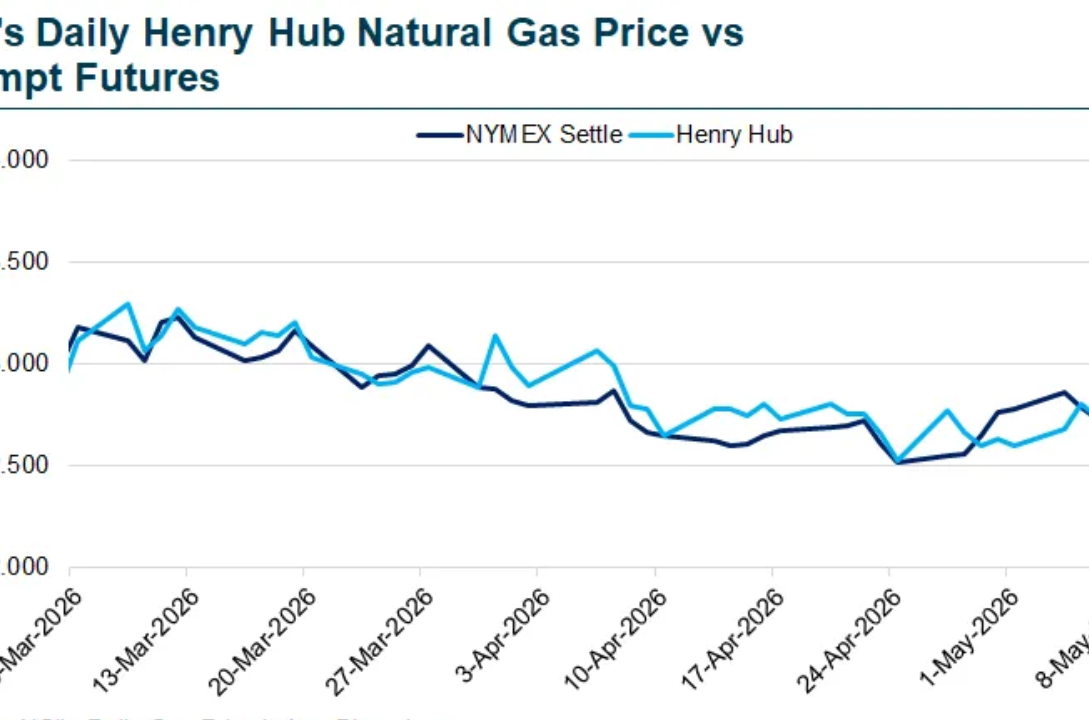
U.S. natural gas futures climbed to a two-month high on Tuesday as warmer weather across the East Coast increased expectations for stronger power demand. The move was supported by a recent decline in U.S. gas production and forecasts showing above-normal temperatures through early June.
Front-month natural gas futures for June delivery on the New York Mercantile Exchange rose 9.0 cents, or 3.0%, to settle at $3.114 per million British thermal units. That marked the highest settlement since March 19 and extended the contract’s winning streak to five consecutive sessions.
The rally came even though overall gas demand forecasts were revised lower. The main reason was reduced flows to liquefied natural gas export plants, which are expected to fall to a 16-week low due to maintenance at several major facilities.
This mixed setup shows how sensitive the gas market has become to weather, power demand, production trends, storage levels, and LNG activity. Heat is supporting prices in the short term, but lower export demand is limiting the bullish impact.
East Coast Heat Drives Natural Gas Demand
The immediate driver behind Tuesday’s rally was the heat wave affecting the U.S. East Coast. Higher temperatures typically increase electricity demand as homes and businesses use more air conditioning. Since natural gas remains a major fuel source for U.S. power generation, stronger cooling demand can quickly lift gas consumption.
Washington, D.C., was expected to reach 99 degrees Fahrenheit on Tuesday, or 37.2 degrees Celsius, according to AccuWeather. That would break the previous daily record. Temperatures were also forecast to reach 96 degrees Fahrenheit on Wednesday, matching the record for that date.
For comparison, the normal high in Washington around this time of year is about 77 degrees Fahrenheit. That means the region is experiencing summer-like heat before the official start of peak cooling season.
The weather impact was clear in power markets. In the PJM grid, which includes Washington and stretches across all or parts of 13 states from New Jersey to Illinois, spot power prices surged 449% so far this week to $229 per megawatt-hour. That is the highest level since January.
Gas-Fired Power Generation Remains Central
Natural gas remains a critical part of U.S. electricity generation. When temperatures rise sharply, gas-fired power plants often provide the flexible supply needed to meet sudden demand increases.
The latest energy data shows natural gas accounting for a large share of weekly U.S. power generation, even as wind, solar, hydro and nuclear contribute to the mix. During periods of extreme heat, gas can become especially important because air-conditioning demand tends to peak during afternoon and evening hours.
This is why weather forecasts matter so much for natural gas traders. A hotter-than-normal forecast can lift demand expectations quickly, especially if power grids face stress or if renewable generation is not enough to cover incremental demand.
Meteorologists expect weather across much of the country to remain mostly warmer than normal through June 3. That outlook helps explain why traders were willing to push natural gas futures higher even with weaker LNG export flows.
U.S. Gas Output Has Fallen From Record Levels
Another supportive factor is the recent decline in U.S. gas production. According to LSEG data cited in the report, average gas output in the U.S. Lower 48 states has fallen to 109.3 billion cubic feet per day so far in May. That is down from 109.8 bcfd in April and below the monthly record of 110.6 bcfd reached in December 2025.
The decline is not dramatic, but it matters because the market is entering a more weather-sensitive period. If production remains below recent highs while cooling demand rises, the supply-demand balance can tighten.
Natural gas prices often respond sharply to even modest production changes when weather demand is strong. The market does not only react to current output. It also reacts to whether production can meet demand during peak periods.
If output rebounds in the coming weeks, it could limit further price gains. If production remains soft while heat expands, prices may stay supported.
LNG Maintenance Limits Overall Demand
The main bearish counterweight is lower LNG export activity. Average gas flows to the nine major U.S. LNG export plants have fallen from a monthly record of 18.8 bcfd in April to 16.9 bcfd so far in May.
The decline is linked to spring maintenance reductions at several plants, including Golden Pass in Texas, backed by ExxonMobil and QatarEnergy, and Freeport LNG.
On a daily basis, LNG feedgas was on track to drop from 16.3 bcfd on Monday to 15.1 bcfd on Tuesday, the lowest level since January 27.
This matters because LNG exports are one of the largest demand sources for U.S. natural gas. When export plants reduce intake, more gas remains in the domestic market. That can offset some of the bullish impact from heat-driven power demand.
This is why LSEG’s total gas demand forecast for the Lower 48, including exports, was held at 97.1 bcfd for both this week and next week. Those forecasts were lower than Monday’s outlook.
The Market Is Balancing Heat Against LNG Weakness
The current natural gas rally is not a simple demand story. It is a balance between stronger domestic power demand and weaker LNG export demand.
On one side, the East Coast heat wave is increasing power-sector consumption. On the other side, LNG maintenance is reducing feedgas demand. The price action suggests traders are giving more weight to near-term heat, lower output, and the potential for stronger cooling needs into early June.
However, the reduced LNG flow prevents the market from becoming fully bullish. If LNG demand were still near April’s record level, the price move could have been stronger.
For traders, this means the market remains vulnerable to sudden shifts. If weather forecasts cool or LNG maintenance extends longer than expected, prices could lose momentum. If heat intensifies and LNG feedgas recovers, the market could tighten more quickly.
Storage Levels Remain Comfortable
U.S. gas storage is another important factor. The forecast for the week ended May 15 showed an expected storage injection of 85 billion cubic feet, matching the prior week’s actual build.
Total U.S. gas in storage was forecast at 2,375 billion cubic feet. That would be above the five-year average by 5.9%, though the surplus has narrowed slightly from the previous week.
Comfortable storage levels can limit upside in natural gas prices. When inventories are above average, the market has a cushion against demand spikes. However, that cushion can shrink quickly if heat persists and power burn remains strong.
For now, storage is not tight enough to create panic buying. But it is also not so excessive that traders can ignore weather risk.
Futures Enter Overbought Territory
The June gas contract has now risen for five straight sessions and remained in overbought territory for a second consecutive day. That is the first time this has happened since January.
Overbought conditions do not automatically mean prices must fall. They show that momentum has become stretched in the short term. If bullish weather forecasts continue, prices can remain overbought for several sessions.
Still, traders should be careful. A market that rises quickly on weather and production concerns can reverse just as quickly if forecasts change. Natural gas is one of the most weather-sensitive commodities, and short-term price moves can be volatile.
The next few sessions will be important. If futures hold above $3.10 and weather demand remains strong, traders may test higher resistance levels. If the rally loses momentum, profit-taking could emerge.
Global Gas Prices Remain Elevated
Global gas benchmarks also remain high compared with U.S. Henry Hub prices. The Dutch Title Transfer Facility was quoted above $17 per mmBtu, while the Japan-Korea Marker was near $19 per mmBtu. That is far above U.S. gas prices near $3.
This wide gap explains why LNG exports remain strategically important for U.S. gas producers. When export capacity is available, U.S. gas can reach higher-priced global markets. When LNG plants undergo maintenance, that demand channel weakens temporarily.
Over the long term, expanding LNG export capacity is one of the biggest structural drivers for U.S. gas demand. In the short term, however, maintenance schedules can create temporary pressure.
Regional Price Differences Remain Wide
Regional U.S. gas prices also show a divided market. Henry Hub next-day gas rose to $3.07 per mmBtu from $2.89 the prior day. Algonquin Citygate in New England rose sharply to $2.99 from $2.14, reflecting stronger regional demand.
However, some western markets remained weak. Waha Hub in West Texas was still deeply negative at minus $3.21 per mmBtu, though it improved from minus $4.40 the prior day. Negative Waha prices often reflect pipeline constraints and excess associated gas production in the Permian region.
These regional differences show that the U.S. gas market is not uniform. Weather, pipeline capacity, local production, export access, and power demand can create very different price conditions across hubs.
What Traders Should Watch Next
The first factor to watch is the weather forecast. If above-normal temperatures continue through early June, gas-fired power demand could remain strong. Any cooling in the forecast would likely pressure prices.
The second factor is production. If output rebounds toward the December record, supply concerns may fade. If production stays near 109 bcfd or falls further, the market could stay supported.
The third factor is LNG feedgas demand. Maintenance-related reductions are currently limiting total demand. A recovery in flows to LNG export plants would tighten the balance.
The fourth factor is storage. Weekly inventory builds will show whether the market is absorbing supply comfortably or whether heat is starting to reduce injections.
The fifth factor is power prices. PJM’s sharp price spike shows how quickly heat can strain regional markets. Continued strength in power prices could reinforce gas demand expectations.
U.S. natural gas futures rose to a two-month high as traders responded to lower production and an East Coast heat wave expected to lift power demand. The June contract settled at $3.114 per mmBtu, extending its rally to five sessions.
The market’s bullish momentum is being supported by hot weather, strong air-conditioning demand, and output below recent record levels. However, lower LNG export flows due to maintenance are limiting overall demand and preventing a more aggressive rally.
For now, natural gas is caught between heat-driven domestic demand and weaker export activity. If the weather remains hot and LNG flows recover, prices could find additional support. If forecasts moderate or exports remain reduced, the rally may cool.
The key message is that weather has returned as a dominant market driver. With summer demand approaching, natural gas traders will be watching every update on temperatures, storage, production and LNG flows.