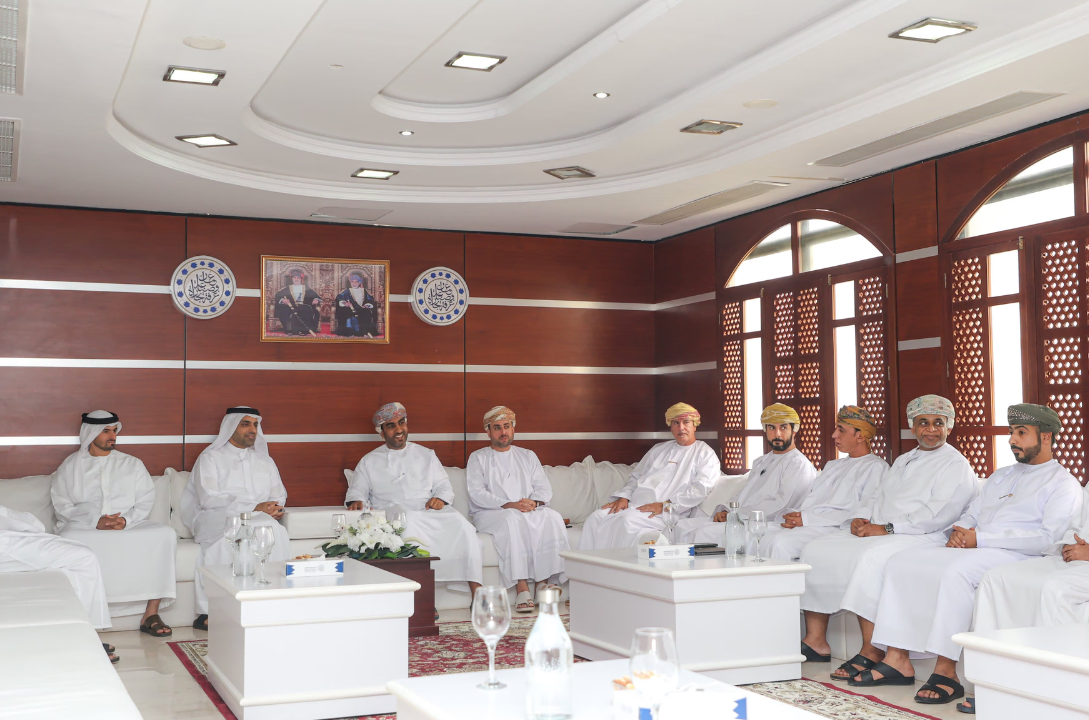
Dubai Chambers has taken a new step in its regional cooperation strategy by carrying out a mission to Sohar, in the North Al Batinah Governorate of the Sultanate of Oman. This visit, led by His Excellency Mohammad Ali Rashed Lootah, President and CEO of Dubai Chambers, follows a very clear logic: to strengthen the smooth flow of bilateral trade between Dubai and Oman, improve logistics connectivity between the two markets, and create a stronger framework for supply chain resilience at a time when Gulf economies are seeking to better absorb external shocks.
Behind the usual diplomatic wording, the issue is in fact highly practical. In an international environment marked by geopolitical tensions, disruptions in global trade, pressure on logistics corridors, and the need for regional economies to better secure the movement of goods, Dubai and Oman have every reason to deepen their coordination. The visit to Sohar therefore does not carry only symbolic or protocol value. It reveals an increasingly clear strategic direction: the building of a Gulf trade space that is more integrated, more agile, and better protected against global turbulence.
The Dubai Chambers delegation met with the branch of the Oman Chamber of Commerce and Industry in North Al Batinah Governorate to discuss bilateral cooperation mechanisms between the business communities of Dubai and Sohar. The discussions focused on several priority sectors, with a stated goal: to unlock higher-value opportunities for companies in both markets and support the growth of bilateral trade.
At the same time, the delegation visited SOHAR Port and Freezone, as well as Sohar Industrial City under Madayn, in order to examine ways to improve the movement of goods, strengthen supply chain resilience, and deepen logistics integration between Dubai and Sohar. This combination of institutional dialogue and field visits matters, because it shows that the cooperation is not staying at the level of intentions. It is seeking to anchor itself in real infrastructure, real trade corridors, and real operational needs.
Cooperation that goes well beyond statements of intent
In his official remarks, Mohammad Ali Rashed Lootah stressed Dubai’s determination to strengthen cooperation with its strategic partners in order to facilitate bilateral trade and improve logistics connectivity. That statement may sound standard at first glance, but it takes on a more specific meaning when applied to the relationship between Dubai and Oman.
Dubai does not need to reintroduce itself as a regional and global trade hub. The emirate has built itself as a platform for transit, services, re-export, finance, logistics, and connectivity. Oman, for its part, and especially Sohar, has increasingly established itself as a strategic zone with growing industrial, port, and logistics strengths. The closer alignment between these two spaces is therefore not just an exercise in regional goodwill. It reflects a deeper economic logic: more tightly connecting a highly dynamic commercial center with a port and industrial platform capable of receiving, transforming, and redistributing flows.
In that context, the cooperation is meant to deliver tangible effects. Streamlining trade does not simply mean reducing administrative delays. It also means thinking through shipping routes, port handling, customs coordination, operational speed, visibility of flows, the quality of storage infrastructure, the interface between industry and logistics, and the capacity of businesses to operate across both markets in a complementary way.
In other words, the goal is not only to increase trade volumes. It is also to make the trade structure more robust, faster, and more attractive for companies looking to invest, produce, import, export, or redistribute across the region.
Sohar is becoming an increasingly strategic partner for Dubai
The choice of Sohar as the focal point of this mission is not accidental. Sohar has gradually strengthened its place in the Gulf economic landscape through its port, free zone, and industrial development. Its geographic position, logistics potential, and ability to host industrial and commercial activities make it a particularly relevant partner in the context of cooperation with Dubai.
For Dubai, working closely with Sohar helps enrich its own regional architecture. The emirate already has a powerful logistics ecosystem, but modern trade no longer depends on a single node. It depends on networks. The more interconnected those networks are, the more capable they are of resisting disruptions. In that logic, stronger ties with Sohar allow Dubai to extend its reach, deepen its network, and create useful complementarities.
For Sohar, closer ties with Dubai also open substantial opportunities. Connecting more closely to Dubai’s economic ecosystem, business networks, commercial depth, and international pull can increase the visibility of Sohar’s port, free zone, and industrial projects. The relationship is therefore potentially mutually beneficial: Dubai gains regional depth, while Sohar gains exposure and integration.
Sohar Port and Freezone at the center of the logistics discussion
The visit to SOHAR Port and Freezone, as well as Sohar Industrial City, deserves special attention. It shows that the mission was not limited to an institutional meeting with the local chamber of commerce. It also aimed to examine directly the practical levers for better integration of trade flows.
The port and free zone are natural meeting points between trade strategy and industrial strategy. In the modern economy, it is no longer enough to have efficient port infrastructure. It must also be linked to transformation zones, distribution capacity, effective customs services, flexible logistics offerings, and attractive setup conditions for companies.
The repeated reference to supply chain resilience is especially important. Over the past several years, the term has become common in global economic language, but it now carries even more weight. Supply chains are no longer judged only by cost or speed. They are also judged by their ability to hold up under disruptions: geopolitical crises, energy tensions, port congestion, regulatory instability, reconfigured trade flows, or rising transport costs.
In that context, strengthening ties between Dubai and Sohar adds another layer of regional stability. If flows can move more efficiently between the two, if companies have complementary operational bases, and if infrastructure becomes better integrated, then the economies involved become less vulnerable to certain external shocks.
The issue is not only commercial, it is also industrial
The cooperation discussed between Dubai and Sohar is not limited to trade in the narrow sense. It also concerns industrial structuring. The presence of Sohar Industrial City on the visit agenda shows that the discussions include how value chains can be spread across different regional hubs.
This is a key point. Dubai has often been identified as a trade and logistics hub, while other Gulf zones have developed more strongly in production, transformation, or industrial anchoring. Strengthening links between these spaces makes it possible to move beyond a fragmented view of regional development. It opens the way to a model in which trade, industry, and logistics reinforce one another.
In that framework, a company might use Dubai as a commercial and financial access point while relying on Sohar for certain industrial or logistics operations. Conversely, businesses already established in Sohar may find in Dubai an accelerator for access to markets, international partners, or distribution networks.
This complementarity becomes even more relevant at a time when Gulf governments are seeking to diversify their economies, attract more private investment, and reduce excessive dependence on traditional sectors. The Dubai-Sohar relationship therefore fits into a broader ambition: building a regional economic fabric that is more diversified, more productive, and more interconnected.
A strategy aligned with Dubai Chambers’ international vision
The mission to Sohar clearly fits within the broader approach of Dubai Chambers. For several years, the organization has stated its intention to strengthen trade and economic cooperation between Dubai and major global markets, create high-impact engagement channels, and connect Dubai’s business community more closely with its international counterparts.
It is important to understand that this vision is not limited to distant major powers or to Western and Asian headline markets. Dubai’s “key markets” also include its immediate regional environment. In the Gulf, the quality of economic relations between neighboring hubs can become a decisive factor in collective competitiveness.
By working with Oman, and more specifically with Sohar, Dubai Chambers is not simply trying to produce another round of institutional cooperation. It is trying to build strategic, high-impact channels capable of delivering operational results and improving private-sector readiness in the face of global developments.
That dimension is explicitly present in the institution’s messaging. Closer engagement with international partners is intended to strengthen the resilience of Dubai’s economy and the private sector’s ability to respond to global developments. This means that the economic diplomacy carried out by Dubai Chambers serves a preventive function as much as a commercial one. It is not only about expansion. It is also about protection.
Resilience built through regional integration
The word “resilience” appears several times in this sequence, and not by chance. In the current period, economic resilience is becoming almost as important as growth itself. The best-performing economies are no longer only those that expand quickly. They are also the ones that can keep functioning when outside conditions deteriorate.
From that perspective, regional integration is no longer a diplomatic luxury. It becomes a tool of stability. The more reliable regional logistics corridors are, the more economic institutions cooperate, the better business communities know one another, and the more intelligently supply chains are distributed, the greater the capacity to absorb shocks.
Dubai and Sohar clearly share this interest. By improving the movement of goods and deepening logistics integration, they are not only increasing bilateral trade. They are also strengthening their ability to navigate periods of global uncertainty with greater flexibility.
That logic matters especially in a region where maritime, energy, and trade dynamics can quickly be affected by external events. Better connections between regional hubs become a form of strategic insurance.
Cooperation that can open new opportunities for the private sector
Beyond the larger issues of logistics and resilience, there is also a much more direct issue for businesses. The Dubai Chambers mission explicitly aims to identify high-value opportunities for companies operating in both markets.
This can involve logistics, distribution, port services, re-export, light industry, transformation, commercial services, agribusiness, tourism, and activities linked to free zones. The diversity of institutions involved in Dubai Chambers’ governance and in Sohar’s economic structure also suggests that the cooperation could extend beyond port-related flows alone.
For the private sector, the value of this kind of rapprochement is straightforward: the more institutions reduce friction, the more companies can deploy effective cross-border business models. And in a region where competition between economic hubs remains strong, the ability to offer a smooth environment for the movement of goods and partnerships becomes a major advantage.
Conclusion
The visit of the Dubai Chambers delegation to Sohar marks an important step in Dubai’s determination to strengthen its economic cooperation with the Sultanate of Oman. Behind the institutional meetings and official statements, the mission reveals a much more structural ambition: to streamline bilateral trade, better integrate logistics infrastructure, strengthen supply chain resilience, and create new high-value opportunities for businesses on both sides.
The closer engagement with the North Al Batinah branch of the Oman Chamber of Commerce and Industry, as well as with SOHAR Port and Freezone and Sohar Industrial City, shows that this strategy is grounded in practical realities. It is not only about strengthening diplomatic ties. It is about consolidating economic mechanisms capable of generating more trade, more coordination, and more resilience against global shocks.
In a more unstable international environment, Dubai and Sohar therefore appear to be betting on a simple but powerful idea: the best way to secure the commercial future is not only to grow faster, but to integrate more intelligently.