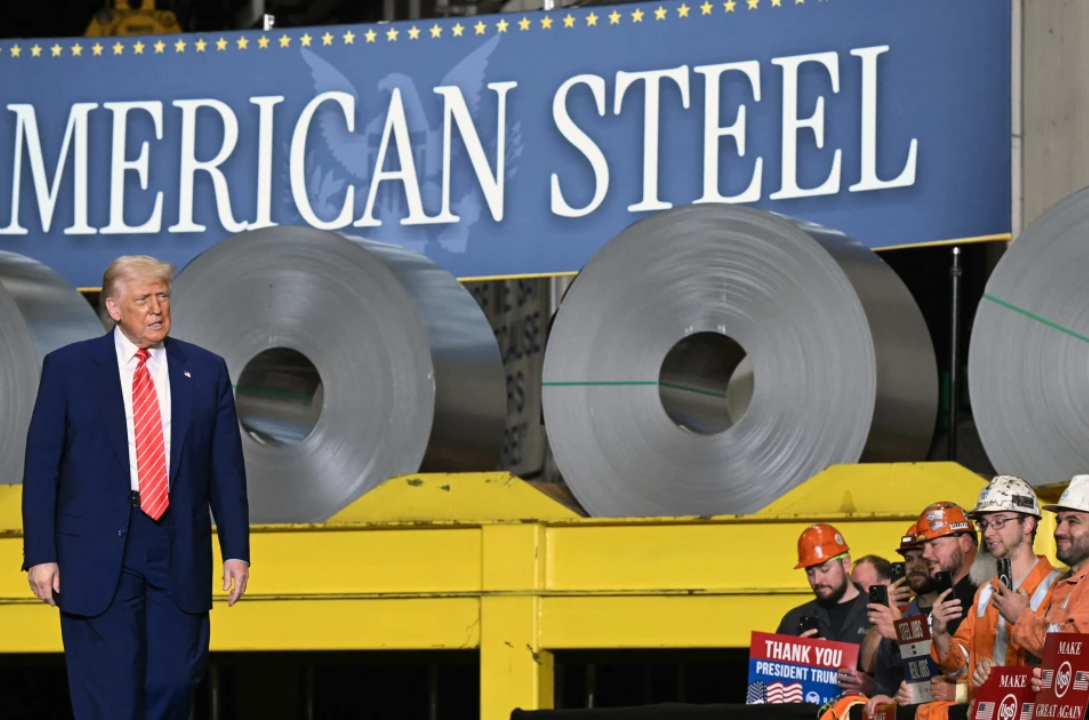
The Trump administration has changed the way it applies tariffs on imported steel, aluminum, copper, and products containing those metals, in what officials describe as an effort to simplify enforcement and better align the tariff structure with broader industrial goals. But behind the language of simplification lies a more complicated political and economic reality: the administration is adjusting a trade policy that has generated confusion, business frustration, and weaker-than-promised results.
The changes were announced on the one-year anniversary of President Donald Trump’s so-called “Liberation Day,” when he rolled out his wider reciprocal tariff push against imports from around the world. The metal tariffs, however, sit under a different legal framework, Section 232 of the Trade Expansion Act of 1962, which allows trade restrictions on national security grounds.
At the center of the latest revision is a shift away from the more complicated method importers had been using to calculate duties on products that contain steel, aluminum, or copper. Until now, importers often had to determine how much metal was contained in a product, apply one tariff rate to that portion, then assess separate duties on the rest of the item’s value. The new approach reduces some of that complexity by introducing more standardized treatment for different categories of metal-intensive imports.
The White House says the new system is not about raising tariff revenue. Instead, it says the goal is to reduce unnecessary complexity and better align incentives with domestic manufacturing priorities. But the timing and substance of the changes suggest another interpretation as well: the administration is responding to growing evidence that its metal tariff framework created distortions, encouraged workarounds, and failed to deliver the economic boom Trump promised.
What the new tariff structure changes
Under the updated framework, the administration’s 50% tariffs still apply to products made entirely of the targeted metals, such as steel coils or aluminum sheet. Those categories remain at the hard end of the policy.
But the treatment of more complex manufactured products is changing. Goods such as washing machines and other products that contain significant amounts of steel, aluminum, or copper will now face a flat 25% tariff, rather than the previous system that required importers to break down the exact metallic content and assign tariffs in a layered way.
That shift matters for one simple reason: compliance had become messy. Importers were not just paying tariffs; they were also paying for legal analysis, classification support, accounting adjustments, and customs interpretation. The old system may have looked precise on paper, but in practice it created a costly administrative maze.
The administration is also making another important adjustment: products containing less than 15% of the targeted metals by weight will no longer face an additional metals tariff. That threshold is significant because it acknowledges that many finished goods contain metal only as one component among many and that applying a full metal-based tariff logic to them can quickly become economically irrational.
For certain categories, there will be intermediate treatment. Metal-intensive industrial equipment and electrical grid equipment will face a 15% tariff through 2027, while products manufactured abroad but made entirely with American steel, aluminum, and copper will face a 10% tariff.
Each of these changes points to the same basic effort: the administration is trying to move from a system that was theoretically strict but practically unwieldy toward one that preserves a protectionist structure while reducing operational chaos.
Why the White House says it had to act
The official explanation for part of the change centers on valuation. A senior administration official said exporters had been sharply reducing the declared value of the metals being shipped to the United States after the tariffs were introduced, thereby lowering the tariff burden attached to those shipments.
According to that explanation, foreign sellers were “artificially” marking down the value of the metal content so that the tariff owed on imported material would be smaller than intended. In response, the White House said the 50% tariff would now apply to the full value of the imported steel and other targeted metals brought into the U.S. and paid for domestically.
From the administration’s point of view, this is about correcting a pricing imbalance and closing a loophole that weakened revenue collection and undermined policy intent. The official argument is straightforward: if the government imposes tariffs to protect domestic industry and collect revenue, but exporters are reshaping invoices to reduce the declared value of the tariffed material, then the policy is not functioning as intended.
The administration also insists that the new measures are not primarily designed to boost tariff revenue, but rather to make the structure more coherent and reduce needless complexity. That may be partly true, but the two motives are not mutually exclusive. A tariff system that is too easy to manipulate can fail both economically and politically. It can frustrate domestic producers, confuse importers, and disappoint an administration that promised stronger outcomes.
The larger problem: pushback and disappointing results
Trade policy experts say the latest revisions likely reflect something bigger than technical fine-tuning. They likely reflect accumulated pressure from U.S. importers, foreign trade partners, and critics who have spent the past year arguing that the tariff structure was too complex, too unstable, and too disconnected from the broad claims made when it was launched.
When Trump unveiled his tariffs last year, he promised sweeping results. He said the tariffs would generate trillions in revenue, trigger an economic boom, attract foreign investment, strengthen domestic manufacturing, and eliminate trade deficits. That was the political sales pitch.
The problem is that the economic reality appears to have been much less dramatic.
Scott Lincicome, vice president of general economics at the Cato Institute, offered one of the sharper assessments: the best thing one could say about the tariffs is that they were not as harmful as some feared. That is not exactly the kind of endorsement usually associated with a transformational economic success.
According to Lincicome and other Cato scholars, what actually rose over the last year was not manufacturing dynamism or foreign direct investment, but rather taxes, prices, uncertainty, and bureaucracy. In their view, U.S. manufacturing, inbound investment, and the trade balance remained broadly flat while compliance burdens and policy confusion climbed.
That criticism cuts to the heart of the issue. Tariffs are often sold politically as simple tools: tax foreign imports, protect domestic industry, encourage local production. But once applied to modern supply chains, they rarely remain simple. Products move across borders multiple times. Inputs come from different countries. Components have different classifications. Businesses need certainty to plan. When tariff regimes become unpredictable or excessively granular, they can end up discouraging investment rather than attracting it.
“No exceptions” turned into complexity and lobbying
Another source of criticism is the gap between how the tariffs were announced and how they evolved. Trump originally said there would be “no exceptions, no deals, no loopholes.” But that hardline framing did not survive contact with economic and diplomatic reality.
Tariff rates shifted. Some of the most dramatic rates, including those imposed on Chinese goods, were later reduced. Exemptions expanded. Lobbying intensified. Companies scrambled for carve-outs. Product treatment changed. Country-specific arrangements multiplied. In effect, what began as a posture of blunt certainty became a complicated system of negotiation, adjustment, and special treatment.
That matters because uncertainty can be almost as damaging as the tariff itself. Businesses can adapt to higher costs if they understand the rules and can plan around them. What they struggle with is a policy environment where the rules keep changing, exemptions are uneven, and outcomes depend partly on political pressure.
This is why critics argue that the administration’s way of applying tariffs — often unilaterally, with different rates for different countries and changing definitions of exempt products — dramatically increased trade complexity. It also weakened the credibility of the original message. A tariff regime that was sold as absolute ended up becoming highly conditional.
The latest round of changes can therefore be read as another chapter in that same story: not the clean implementation of a stable industrial policy, but the ongoing repair of a system that proved far more difficult to administer than advertised.
Steel and aluminum were already expensive before Iran made things worse
One of the more important background points in the debate is that U.S. aluminum and steel prices were already significantly above world-market levels before the latest geopolitical escalation. Critics say domestic prices were roughly twice as high as world-market benchmarks even before the current Middle East crisis intensified.
That matters because tariffs do not operate in a vacuum. If domestic buyers are already paying elevated prices for inputs, then additional protection or import friction can compound existing cost pressures. For manufacturers that rely on these metals, the result can be a squeeze: they face higher input costs than foreign competitors while also being told that tariffs are meant to strengthen American industry.
The U.S.-Israeli war with Iran has worsened that pressure. The conflict has pushed up global prices and also reportedly limited access to aluminum sources in places such as the UAE and Bahrain, which are important suppliers. That means U.S. manufacturers now face not only tariff-driven pricing issues, but also a war-driven supply problem layered on top.
This is where the political logic of the tariff changes becomes more understandable. The administration is trying to preserve protectionist credibility while acknowledging that the old structure was too cumbersome for a world already under strain from geopolitical disruption.
Simplification may help, but it does not solve the deeper contradictions
There is little doubt that the revised tariff approach may make life somewhat easier for importers compared with the prior calculation-heavy system. Flat rates for some categories, a de minimis-style threshold for low-metal-content products, and a special treatment structure for equipment all make the framework easier to administer.
But simplification should not be confused with resolution.
The deeper contradictions remain. The U.S. still wants to protect domestic metal production, support manufacturing, and use tariffs as leverage. At the same time, many U.S. manufacturers depend on imported inputs, operate in globally integrated supply chains, and now face higher costs not just because of trade policy but because of war-driven energy and supply disruptions.
Tariffs can shield some upstream producers while hurting downstream manufacturers. They can raise government revenue while increasing prices for businesses and consumers. They can signal industrial resolve while creating administrative overload. All of that can be true at once.
The latest changes make the system cleaner in some respects. But they do not eliminate the basic tension between protection and efficiency.
What businesses will be watching now
For importers and manufacturers, the next question is practical: does the new framework reduce enough uncertainty to improve planning? Businesses will want to know whether the rules are now stable, whether customs enforcement becomes more predictable, and whether the threshold and flat-rate structures are likely to hold.
They will also watch whether the revised system reduces litigation, classification disputes, and lobbying pressure. If it does, the administration may be able to claim some success in improving execution. If it does not, then the changes may be seen as only a modest redesign of a still-problematic framework.
For investors, the broader issue is whether these tariff revisions signal flexibility or underlying weakness. Bulls may argue the administration is adapting pragmatically to make policy more workable. Skeptics may argue the administration is backtracking because the original promises did not materialize and the old structure proved too burdensome.
Both readings can coexist. Trade policy often evolves this way: initial rhetoric aims high, practical implementation stumbles, and then adjustments arrive under the language of efficiency.
Conclusion
The Trump administration’s new changes to steel, aluminum, copper, and metal-content tariffs are being presented as a simplification effort. In one sense, that is exactly what they are. The system is moving toward flatter rates, clearer thresholds, and fewer calculation burdens for complex products.
But the timing and substance of the changes also suggest something else: the administration is responding to a year of criticism, workarounds, and disappointing outcomes. Exporters reportedly found ways to reduce declared values. Importers complained about complexity. Critics argued that prices, bureaucracy, and uncertainty rose while manufacturing gains remained elusive.
Trump originally promised a tariff-driven economic boom with no exceptions and no loopholes. What emerged instead was a more complicated, more politically negotiated, and more administratively difficult trade regime. The latest revisions may improve some of its mechanics, but they do not erase the central question that has surrounded the policy from the beginning: whether tariffs of this kind can deliver broad industrial revival without imposing equally broad economic friction.